12 August 2013

Prior Knowledge Goes From TechCrunch Disrupt Finalist To Salesforce.com Skunkworks Project

Prior Knowledge made it to the finals last year at TechCrunch Disrupt SF. They did not “wow” the judges, but their predictive database technology for developers certainly turned attention to what they do.

Three months later, Salesforce.com acquired Prior Knowledge for an undisclosed price. And then Prior Knowledge shut itself down — permanently. They killed their flagship API, erased all the user data, shut down the website and erased all traces of their work on GitHub.

The decision to shut down the service and go into super secret mode came as Salesforce began to put the pieces together for its marketing cloud and the reinforcement of its developer platform. But they lacked a crucial piece — the ability to do sophisticated predictive analytics in a way that made it easier for customers to see connections and make decisions.

Enter Prior Knowledge, which had developed what it called the Veritable API, a service that Co-Founder Eric Jonas had said gives developers super powers to build powerful applications with predictive analytics baked in. Salesforce.com does provide analytics to drill down on sales and social media data. It does not, though, have the capability to build a graph in the shape and form of a service like LinkedIn, which I wrote about last month:

Since its start 10 years ago, LinkedIn has become the place for people to network. In recent years, though, it has started pooling the data, becoming one of the early adopters of open-source data technologies, such as Hadoop and Lucene/Solr for search. It has one of the most-recognized teams of data scientists who have learned to shape the data to create what CEO Jeff Weiner calls a global economic graph. It’s through the understanding of its users’ interactions that LinekdIn is establishing a platform that could put it in a position to emerge as an enterprise services provider and a player in the CRM market.

A year later, Jonas is keeping quiet about the work he and his team are now doing at Salesforce. Jonas, who is now chief predictive scientist at the company, declined an interview for this story, only hinting at some news to come for the work his team is doing. Here’s what he said in an email about his new role: “I work on discovering applications for our technology, work on research prototypes, and scientifically guide the team that works on predictive analytics and machine learning.”

Jonas was working on his doctorate in neurobiology at MIT when he took a leave of absence to work on Prior Knowledge. He and his team of statisticians, engineers and mathematicians received $1.4 million in funding from The Founders Fund to develop a service that basically modeled the knowledge of the team into the technology itself. It is reminiscent of Wise.io, the machine learning as a service that harnessed the knowledge of a team of astrophysicists from the University of California at Berkeley. Co-Founder Joshua Bloom said at their launch that he and his colleagues at Berkeley would often manage data that was well beyond what conventional tools could offer. They had to invent the technology themselves. Now all that knowledge is getting packaged to offer as a service.
A Few Clues

There are clues scattered about that tell a story about the direction Salesforce is taking. Beau Cronin was a co-founder at Prior Knowledge. He is now a senior manager of predictive products at Salesforce and contributor to O’Reilly Radar. In a post last April he wrote about the need for robust analytics and essentially the importance of Prior Knowledge:

I find the database analogy useful here: developers with only a foggy notion of database implementation routinely benefit from the expertise of the programmers who do understand these systems — i.e., the “professionals.” How? Well, decades of experience — and lots of trial and error — have yielded good abstractions in this area. As a result, we can meaningfully talk about the database “layer” in our overall “stack.” Of course, these abstractions are leaky, like all others, and there are plenty of sharp edges remaining (and, some might argue, more being created every day with the explosion of NoSQL solutions).

Making the point how the database has become abstracted sums up what the Prior Knowledge team set out to do. And that’s simplifying the complexity of adding deep analytics into apps. That’s a daunting task for most developers these days. Salesforce has an aggressive mobile strategy. Much of their work has historically focused on making it a bit easier to develop apps. The latest update of its mobile platform points to this effort. Making analytics easier to implement would dovetail with Salesforce strategy.

Furthermore, Salesforce has made some substantial investments in its marketing cloud. Predictive analytics for mobile marketing is a gold mine that Salesforce is surely seeking to tap.

The secrecy I encountered points to the value that the Prior Knowledge technology has to Salesforce, which has invested heavily in building platforms for app development but has left predictive analytics pretty much out of the equation. The Salesforce Data.com platform has a degree of analytics but it is primarily marketed as a sales lead database. The lacking predictive analytics capability is a missing piece, pointing to a weakness in the company’s overall product strategy that the Prior Knowledge technology should help shore up. But even more so it is the people from the team who can direct the scientific path for Salesforce to follow so they might find that data gold mine.

Oh, and for your reference, here is Jonas presentation at last year’s event. Not exactly the most compelling of presentations but certainly enough to get attention for the power the technology offers.


11 August 2013

New Rule: Congressmen Who Thought Iraq Had WMDs Can’t Talk About NSA Effectiveness

Senator Saxby Chambliss is either a blind war hawk or is deliberately misleading the public. Last week, after the National Security Agency had intercepted an al-Qaida conference call plotting attacks against U.S. embassies, Chambliss claimed it was proof that mass surveillance programs were effective. But the AP reports that the NSA’s controversial phone and Internet monitoring programs “played no part in detecting the initial tip.”

The press should have known — and reported on — the fact that Chambliss had a history of hawkish interpretations of intelligence reports after he voted for the Iraq War in 2002. Indeed, the most ardent defenders of the NSA are exactly those members of Congress who wrongly believed we needed to invade Iraq after believing that there was an imminent threat from Saddam Hussein’s Weapons of Mass Destruction.

Since the public can’t scrutinize classified documents, we have to trust that elected representatives are capable of critically evaluating intelligence reports. Anyone who voted for the Iraq War has lost the public’s trust and shouldn’t be allowed to comment on the NSA — without getting hammered by the press and party leaders.

It’s not just Republicans who voted for the Iraq War. “Please know that it is equally frustrating to me, as it is to you, that I cannot provide more detail on the value these programs provide,” said Dianne Feinstein, a member of the Senate Intelligence Committee and one of the NSA’s most ardent supporters. Feinstein argues that NSA surveillance prevented the Najibullah Zazi 2009 New York subway bombing, but public documents reveal that it was local law enforcement that got the first tip during the course of searching his co-conspirators’ computers. Feinstein was wrong about the impending threat of Saddam Hussein in 2002, so why should we believe her now?

Feinstein’s Senate Intelligence Committee colleague, Ron Wyden, who voted against the Iraq War, has seen the exact same intelligence reports on the NSA and concluded there is no evidence mass surveillance was critical to stopping attacks. “I’ve seen zero evidence it is needed,” he tweeted
In a public statement, Wyden further argued, “Saying that ‘these programs’ have disrupted ‘dozens of potential terrorist plots’ is misleading if the bulk phone records collection program is actually providing little or no unique value.”

Perhaps we should heed Wyden’s advice. Back in 2002, during the ramp-up to the Iraq War, he wrote:

“First, I am not convinced, regarding a clear and present threat, Saddam Hussein currently imposes a clear and present threat to the domestic security of the Nation. While my service on the Senate Intelligence Committee has left me convinced of Iraq’s support of terrorism, suspicious of its ties to al-Qaida, I have seen no evidence, acts, or involvement in the planning or execution of the vicious attacks of 9/11.”

Voting for or against the Iraq war should have permanent consequences for each member’s reputation, and the press needs to qualify the statements of our elected officials every time they speak on intelligence issues.

Yet, a member’s vote on the Iraq War isn’t completely sufficient for us to trust them, either. Representatives can be influenced as much by personal convictions as the political calculations of re-election.

As a result, two former judges of the court charged with approving NSA requests, The Foreign Intelligence Surveillance Court (FISC), have proposed a “public advocate” — a lawyer specially appointed to defend civil liberties. This independent advocate would be free of both the military hierarchy and the political machinations of Congress. We hope Congress will let this advocate speak to the American people and voice his own confidence in the value of our intelligence systems.

If both an advocate of the people and a critic of the Iraq War saw evidence that the NSA had, indeed, foiled attacks, citizens would have all the confidence they needed to make a more informed choice.

Until then, Feinstein and Chambliss need to step out of the limelight and let someone with credibility talk. And if they dare to keep on talking, the press shouldn’t let them get away with it.

Harry Houdini, Lock Picking, And Entrepreneurship

Editor’s Note: Semil Shah is a contributor to TechCrunch. You can follow him on Twitter at @semil.

It’s summer here in Silicon Valley, and for my column this month, I’ll try to finally polish and publish some of the old posts that have been collecting dust in my “drafts” folder. Usually, I try to make the column timely, but not this time. Almost two years ago now, my wife and I visited a museum in San Francisco to an exhibit called “Art of Magic,” honoring Harry Houdini. I dragged my wife to the museum to see this because I had been watching “Pawn Stars” (favorite show!) on the History Channel and was obsessed with the show. In one episode, a customer came in with original handcuffs and a straightjacket used by Houdini. The show’s characters all marveled at the legend of Houdini, the nostalgia, the myths. While all this information is available on Wikipedia, the art exhibit highlighted an interesting them: Houdini’s masterful command of new mediums and platforms to manipulate and leverage his audience’s deepest hopes and fears.

Reflecting on that experience, and as it’s the annual time for Defcon, where the art of lock-picking is a time-honored tradition, I wanted to cast Houdini in a different light and showcase how some of his techniques could, in fact, be leveraged by modern-day entrepreneurs. It may be a stretch, but please bear with me.

The common thread weaved through most of Houdini’s famous tricks seemed rooted in the juxtaposition of his audience’s fear of death versus their hope for liberation. The part of Houdini’s history that impresses me most is how and why some of his tricks became iconic signature moves. For instance, he rose to fame as the “Handcuff King,” setting up elaborate schemes to unchain himself from all sorts of iron shackles, but he didn’t just adopt handcuffs as some ruse — it turns out that, as a young boy growing up poor, he took a job as an apprentice with a local locksmith to earn extra money for his struggling family.

Houdini also became famous by taking himself handcuffed and dipping into water, invoking a fear of drowning — he had studied old waterboarding-like contraptions used to torture people in the middle ages, and new the audience would be captivated by the sight. Or, randomly, Houdini visited a psych ward early in his career and happened to see a few patients violently trying to free themselves from their straightjackets, and after practicing escaping from a similar jacket for nearly a decade, he finally unveiled his new trick, usually in public squares, hanging upside down, his head dangling above the crowds, freeing himself and stretching out his hands in victory.

I am still processing why Houdini is so fascinating to me. Pictures like these, where a crowd fixates on him with their undivided attention, are truly incredible. I think Houdini interests me because, as a performer, he captivated his audience and was so precise with his choreography, enabling him to tap into very deep parts of the human psyche with a scalpel’s precision. In a way, this is what the great entrepreneurs do. They are deeply motivated and practice for years. They are in tune with their customers hopes and fears. And, there’s a bit of magic in all of the myths they create. It’s why pictures of a young Steve Jobs sitting on a wood floor with one light stand and some books still continue to fly around the web and evoke both nostalgia and disbelief.

The reason I originally drafted this post is because, almost two years ago, after visiting this exhibit, I was hanging out with an investor and former founder/operator in the Valley who used to go to Defcon as a teenager and pick locks all the time. I told him about Houdini, and he shared stories about how lock-picking was one of the first types of hacks he did as he began to fiddle with computers over two decades ago. We traded a few emails that week and, in one exchange, he asked me what entrepreneurs and investors could learn about Houdini’s background, his rise, his creativity, and his stage presence. Because, in a way, to the crowd, great entrepreneurship looks like magic, a mix of light-bending and mirror tricks that together form a new reality. In this way, magic and making are more alike than they are different.

Here was my email response to the question:


The Power of Cumulative Effects: Houdini’s lock-picking as a boy, his experience in the psych ward and seeing the straightjackets, and his research around the magic and fear of drowning all led him to craft a product (his “act”) that combined all three to prey upon primal fears and hypnotize his audience. In retrospect, Houdini’s signature acts now seem obvious, but one has to wonder if he could have brought all the elements together without having those strong experiences earlier in his life.


Developing Expertise Through Focus: Houdini was a student of magic, amassing over 4,000 books on the subject, the largest ever collection of that genre in the world. It reminds me of when DJ Shadow was becoming famous, how he would scoop up and buy vinyl record collections and build a stockpile years ahead of his competition.


Idle Hands Are The Devil’s Play Things: Even as a child, Houdini could’ve futzed around, but given his family’s financial troubles, he remained active and enterprising, eventually landing an apprenticeship in a profession (locksmithing) that would lay the foundation for his signature moves. He kept moving, kept occupied, and kept in motion.


“Win The Crowd” – Houdini’s genius was in combining all the elements, physical and psychological, to put his audience into a trance, to fixate all of their attention on him. That is what the greats do, their work draws in all of our attention, and we stand in awe watching instead of doing. It is what separates the few greats from everyone else. Houdini was a master at winning the crowd over. It reminds me of one of my favorite quotes from a movie. In Gladiator, Proximus says to Maximus, “I was not the best because I killed quickly. I was the best because the crowd loved me. Win the crowd, and you will win your freedom.”

30 New Franchises

Editor’s note: Scott Weiss is a partner at Andreessen Horowitz and the former co-founder and CEO of IronPort Systems, which was acquired by Cisco in 2007. He works with companies like Lyft, Dwolla, Platfora, App.net and Quirky. Follow him on his blog or on Twitter @W_ScottWeiss.

There is a perfect storm of three distinct disruptive forces that has the potential to topple nearly every major enterprise software incumbent. And the traditional approach of dealing with technology shifts — through acquisition — looks like it’s headed toward failure. As such, there is an unprecedented opportunity to create many new multi-billion-dollar enterprise franchises that are on the right side of these forces and are willing to go the distance in the face of ridiculously high acquisition offers.

Let’s examine these forces individually.

Software as a service (SaaS): Seemingly a little long in the tooth as a disruptor, SaaS has finally gone mainstream in the Global 2000. The primary disruptive force of this technology is the speed of innovation. The feedback loop is especially powerful: As opposed to using focus groups and surveys to figure out how users are interacting with the product, SaaS companies can see what their customers are doing real-time by capturing and analyzing every click. They quickly extend their products through a “cell division” that continuously builds out and A/B tests the features that are getting the most engagement. On-premise and client (PC) software-based product cycles can’t possibly compete here as new releases are typically pushed 10 times faster at 45-60 days vs. 18-24 months.

There’s always one version/code base so it’s much easier to support, patch bugs, and roll out new features to all customers at once. The old joke of “How did God create the world in seven days? He didn’t have an installed base!” certainly applies – but SaaS also demands entirely new skills sets associated with running a 24×7 services business. Dev/Ops, customer care centers, network operations and delivering uptime via failover, mirroring and hot backups are all new and essential. It’s easy to see how the early SaaS pioneers gained so much ground with this innovation but even they are unprepared and poorly architected to take advantage of the additional disruptors that have hit more recently…

Cloud infrastructure: As I detailed in a prior post, “The Building is the New Server,” the humongous Internet powers, Facebook and Google, are literally breaking new ground in re-imagining the design, components and cost of running a hyper-scale data center. The cloud infrastructure they are pioneering has the primary disruptive force of massively driving down cost. Facebook, for instance, is experimenting on the bleeding edge of solving the new cost bottlenecks of power and cooling. I recently read that it actually rained inside one of their datacenters.

The cloud service providers (CSPs) are following their lead using commodity components, open source software, data center design and testing software defined storage and networking products to enjoy the same, devastating cost curve. The corporate datacenters (aka “private clouds”) will slowly disappear as Global 2000 companies migrate to these irresistible new cost curves. Don’t be fooled that security and reliability concerns will keep large enterprises away — as the CEO of IronPort, I watched in horror as large enterprises started pointing their treasured Mail Exchange (MX) records to cloud services like Postini – a much superior and vastly cheaper cloud based architecture versus our perimeter appliances. And email is the most sensitive and mission critical of applications…

Mobile: About two years ago, all of our consumer companies went through an “Oh shit!” moment with mobile. One year mobile was 10 percent of traffic and the next year, when everyone was expecting ~20 percent, it was 30 percent on its way to 50 percent. Facebook, for instance, famously bought Instagram for $1 billion and then continued their pursuit of talent to redesign for mobile. The new mobile operating systems and devices are proliferating an entirely new interaction and design paradigm that has the primary disruptive force of a reimagined user interface.

The innovative use of touch/gestures (e.g. pull down, swipe, pinch etc.) pioneered by the consumer applications will become de rigor for enterprise, as well. Although it’s still early, the mobile sensors (e.g. GPS, accelerometer, video etc.) will also become integral and spawn new innovations in the enterprise as they have enabled new consumer franchises like Lyft and Instagram.

The No. 1 problem facing so many of the startups I talk to is hiring the design talent (e.g. mobile app, front-end engineering and user interface) to take advantage of this trend. In addition to being in ridiculously high demand, most of these people are “arteests” who eschew just cash and stock as incentives because they want to work for a purpose and in an environment where design is an overarching priority/core competency – not something that is grafted on afterwards. These environments are hard to find.

So exactly why won’t these big incumbents make it to the other side? There are just too many things changing at once. Beyond the technology changes, there are structural impediments as well. The incumbent sales forces have become farmers instead of hunters. They still sell on relationships (e.g. A round of golf, anyone?) and bundling/discounting instead of product attributes. They sell to the CIO instead of the line of business buyer who is making the decision. The quotas and incentives are too different. The accounting systems don’t speak recurring billing and revenue. Ugh – it’s just too much change.

A handful of exits have been priced based on a NTM revenue average of 11X vs. around 4X for the rest of SaaS companies. Examples include Workday, Splunk, ServiceNow, Marketo and Tableau. Not to mention the SuccessFactors deal (done at 11X) has officially kicked off the next wave of consolidation. On the private side, companies like New Relic, AppDynamics and ZenDesk have seen private transaction multiples of between 9X and 11X.

There is outright panic going on right now at the large incumbents as they pay ridiculous premiums for the early SaaS companies. And so why won’t these acquisitions pan out? Most of the early SaaS companies weren’t architected to take advantage of the cloud infrastructure cost advantages and most completely missed the boat on mobile. It’s hard enough for new, cool enterprise startups to hire the necessary design talent, but the large incumbents really have no hope.

Next Up

As I’ve said, there is a perfect storm of three distinct disruptive forces brewing which has the potential to erupt into a new multi-billion-dollar wave of enterprise franchises. In particular, there will be at least 30 new enterprise franchises that will go the distance and resist high acquisition offers, as they either supply or ride this trio of disruptors to dominance.

Among others, the new suppliers are companies like Cumulus Networks, Okta, New Relic and Nimble Storage. The “riders” are awesome trifecta companies like Box, Evernote, Base, Expensify and Tidemark.

Where will these 30 New Franchises come from? A double investment cycle in SaaS, as the large incumbents buy the early SaaS pioneers and fumble them, will pave the way. Like Lenny from “Of Mice and Men,” they will smother these companies with too much negative attention, mismatched sales forces and misunderstood business models. Following a short vesting period, the product and management talent — who are used to working at a completely different pace — will ultimately leave the incumbent, resulting in a bevy of entrepreneurs that roll out to start even more of these franchises.

I can’t wait to meet them!

E-Cig Companies Will Never Promise To Help You Quit Smoking

Two or three years ago, e-cigarattes were exotic. These strange sticks, their ends LED-lit and their owners expelling odorless smoke – “It’s vapor!” – would look as futuristic as a Replicant’s food injector. They gave the smoker nebulous powers, namely the ability to smoke on a plane, and they were expensive and hard to find.

Now, they’re everywhere. Even Leonardo DiCaprio was caught sucking on one on set. But are they safe? And what will they really do for the hard-core smoker?

Today the e-cigarette industry is worth around $3 billion globally, outpacing the entire stop-smoking industry including patches, gum, and other addiction killers.

Yet unlike smoking cessation products, which are sold over the counter in pharmacies, e-cigarette companies will never, ever make a claim that e-cigs will treat smoking addiction. In fact, these companies claim the opposite in their marketing materials, citing that they are not intended “to treat, prevent or cure any disease or condition.” This is the same language that appears on other dubious health concoctions

Even though it seems obvious that e-cigarettes are meant to help people tame their addiction to analog cigarettes — and there is even anecdotal evidence suggesting they are more effective than smoking cessation therapies — the claims made by these companies will partially determine the fate of the entire industry.

But before we get into the regulation of tomorrow, let’s look at the history of the tobacco industry.
A Brief History

In 1906, the Food and Drug Administration was created under President Theodore Roosevelt. In 1938, the FDA passed the Food, Drug, and Cosmetics Act, giving the federal government jurisdiction over products like foods, medicines, and other substances that could harm the public health.

For years, that didn’t include tobacco products. It was only in 2009, under President Barack Obama, that the Family Smoking Prevention and Tobacco Control Act (FSPTCA) was put into place, giving the FDA the power to regulate the Tobacco Industry.
Before this, big tobacco was allowed to experiment with new products and market their wares however they pleased, with regulation coming from state governments. In the 1950s, the realities of smoking were just beginning to show their ugly head. We began to realize there was a clear connection between smoking cigarettes and developing cancer and other fatal illnesses.

So what did the industry do? They created something called “harm reduction products”, which were meant to be “safer” than your usual cigarette. In the beginning, this simply meant adding a filter. By the 80′s, companies were taking it a step further.

RJ Reynolds introduced a type of smokeless cigarette called Premier, which seemed to disgust everyone and eventually went off the market, only to resurface itself as the Eclipse. The American Cancer Society claimed that the Eclipse line, which went on sale in 2000, was not as safe as the marketing campaign suggested, as it still delivered carcinogens and other harmful substances.

In other words, harm reduction has long been a strategy for Big Tobacco to keep sales up in the face of… well, cancer. Keeping that in mind, it’s not too much of a surprise that harm reduction products have never really taken off. Until now.

E-Cigarettes and Harm Reduction

In public perception, smoking cessation products are the good guys. These are the products like Nicoderm CQ and Nicorette that are sold by pharmacies only, used for a temporary period, and regulated as treatment and/or therapy. I quit smoking for a while with the help of the patch, and got more congratulations during that period then I did graduating from NYU, winning State Championships in volleyball, or landing a job at TechCrunch.

Harm reduction products, on the other hand, seem like ploys. Many people hear “safer” and “cigarette” in the same sentence and assume it’s yet another trick to increase sales.

But e-cigarettes are different. The movement wasn’t led by Big Tobacco. The e-cigarette industry began to boom in 2007 led by hundreds of smaller companies. Eventually, Big Tobacco took notice. Unlike the patch, or the gums, e-cigarettes actually made a dent (a small, but noticeable one) in cigarette sales.

Rather than fight it, major tobacco companies are now investing in e-cigarette offerings. Lorillard, the maker of Newport, Maverick and Old Gold cigarettes acquired Blu eCigs for $135 million in April 2012. Reynolds American, which makes Camel, Pall Mall, Kool and others, is now selling its own Vuse e-cigarettes in select cities as a trial run. And Altria (formerly Phillip Morris), seller of Marlboros, now sells an e-cigarette line named MarkTen.

This has pushed distribution of e-cigarettes far beyond what small, independent companies could ever manage.

However, Big Tobacco’s involvement is a double-edged sword. While distribution is greatly increased, pushing these devices into the far reaches of the country, big tobacco also gives off the perception that these devices, like the products they’ve sold for centuries, will probably kill you.

“What are these products?” asks Dr. Michael Siegel, Professor at Boston University’s Public School of Health and supporter of e-cigs. “Are they harm reduction or are they smoking cessation? It’s a tough situation because, on the one hand, you have what it does and on the other you have the claims are that are allowable under the law. It’s a strange situation where they are being regulated as tobacco products. But they are not tobacco products. There’s no tobacco in them

Safety

To be clear, any product that delivers nicotine into the human body is automatically considered “unsafe.” That’s the nature of nicotine itself. It’s not meant to be in our bodies.

That said, smoking cessation products like Nicoderm and Nicorette are automatically forgiven. Their purpose is to wean you off the nicotine addiction, and then be discarded. No one quits smoking and says, I’m going to use the patch for the rest of my life. That’s not how it works. In fact, doctors who prescribe smoking cessation therapies have strict limits on how long they can continue to provide the patch, gums, etc.

E-cigarettes are different. These companies don’t want you to quit smoking entirely; they simply want you to switch from smoking to vaping. In fact, the business model is built around your return. The idea is that you pay a larger sum up-front, for the device and a first set of cartridges, making an investment in it, and then return to buy refills
In this way, e-cigarettes are simply a cigarette alternative, and not a therapy to help you quit.

But even though e-cigarettes deliver nicotine into the body, and for an extended period of time, many experts agree that they are much, much safer than combusting cigarettes.

Right now, however, clear cut information on their safety is limited. To start, there have been no finished clinical trials to measure the difference, and holding a clinical trial that is effective becomes difficult knowing that subjects would be exposed to a known carcinogen.

Moreover, the lack of regulation here allows e-cigarette companies to be lazy or negligent. The nicotine dosage may vary from one product to the next, or perhaps they’re using something other than propylene glycol (the standard liquid found in e-cigarettes). They might even have a shoddy battery or wiring that exhausts burning plastic along with the nicotine.

Many e-cigarettes are manufactured in Asia, sold at gas stations, and the consumer is none the wiser that these products haven’t been checked out by any governing body. In short, there is no oversight.

Thankfully, according to Dr. Siegel, e-cigarettes are “orders of magnitude safer” than combusting cigarettes.

“Even if e-cigarettes only cause a five to ten percent reduction in cigarette consumption, you have to understand that from a public health perspective, that is an enormously positive impact,” said Dr. Siegel.

On the other hand, it’s the lack of regulation that makes e-cigarettes potentially dangerous. So what can be done?

Regulation

This is where things get tricky.

The FDA is set to regulate the e-cigarette industry over the next year, at the latest. How they will regulate them is anyone’s guess.

There are three possible scenarios:

The first is that e-cigarettes will be regulated just like traditional cigarettes, with rules on how they can be marketed. This would still allow for distribution, letting e-cigs be sold anywhere traditional cigarettes are sold, but it would limit these companies’ ability to market themselves as a cigarette alternative, or at all.

The second option is that these products will be regulated in the same way as smoking cessation therapies. They would be sold only in pharmacies, over the counter. This would limit visibility and distribution enormously.

The third option is that the FDA will create brand new regulation for e-cigarettes, which would covers things like dosage, materials used, quality control testing, etc. but would still allow for broad distribution and marketing.

There is a raging debate right now over these options, or more pointedly, the time it will take to get to these options. Those that are pro-e-cigs want to ensure that the regulation is fair, and are willing to wait as long as they’re waiting for something close to option three.

Others believe that the e-cigarette companies are purposefully stalling, asking the FDA to wait for more hard evidence on the effects of e-cigarettes (especially compared to traditional cigarettes) in order to grow marketshare in an unregulated field. They see this as a huge risk considering that the e-cig industry is growing rapidly, and these unregulated products are in the hands of more and more unknowing consumers every day.

Bloomberg is even working to essentially ban e-cigarettes in New York.

Big Tobacco’s involvement in the matter only muddles things further. The industry doesn’t have a great track record when it comes to reducing public harm (or even admitting their products cause it in the first place), so in a way, Big Tobacco’s investment in the industry almost discredits e-cigarettes as just another marketing ploy.

On the other hand, Big Tobacco has the brawn to lobby the FDA in a way that these small manufacturers wouldn’t be able to do. Thanks to Big Tobacco, e-cigarette companies now have a voice in the pending regulation of their products.

The future of the industry is surely in question, but one thing is quite certain: this isn’t the last you’ll hear about e-cigarettes and the debate is heating (not burning) up.

Sony’s Xperia Z Ultra is a powerful phone that’s too large for your hand

Mobile phones started off their life as rather large devices, but the industry worked hard to miniaturize them, and after years and years of progress, managed to produce tiny, powerful phones. Now, as smartphones take over the mobile device industry, their screens become larger, increasing the size of the devices once again. At the moment, this trend culminates in Sony’s newly announced Xperia Z Ultra, an enormous 6.4-inch smartphone.

It’s strange to think that the industry spent around a decade minimizing the size of mobile phones — even creating the flip phone so we could halve the space our phones occupy — only to be working diligently to increase the size of them once again. This time, at least, large, pretty screens are an arguably worthwhile reason to increase our phone size, and Sony’s Xperia Z Ultra certainly supports that notion with its 6.4-inch 1080p Triluminos (essentially Sony’s Retina, more or less) display. Though the Ultra is certifiably enormous for something marketed as a phone, it’s still quite thin at 6.5mm, but due to its sheer size, it still weighs a hefty 212 grams for a genre of device traditionally used with just one hand.
Regardless of how ineffective-for-a-portable-phone the size of the device might seem, it does stock some powerful components within its guttyworks, specifically Qualcomm’s 2.2GHz quad-core Snapdragon 800. Along with the top-of-the-line SoC, the Ultra comes with 16GB of on-board storage (11GB of which is available), but if that seems a bit low the phablet has a MicroSD slot that can house a 64GB card. The Ultra will be LTE capable — though which bands have not been disclosed as of yet — and will sport a 2-megapixel front-facing camera, and an 8-megapixel rear facing camera that can take HDR images and video.

The screen, aside from being large and pretty, is also able to recognize more than just a capacitative stylus, as it will accept input from a pen with a tip larger than 1mm, or any graphite pencil — though you likely won’t want to be writing on your new phablet. The phone is also dust- and waterproof to a degree, with IP55 and IP58 ratings.

The original Xperia Z — the one that isn’t a result of mad phone science — suffered from poor battery life of only around three to four hours of use. The battery in that phone — which has a smaller 5-inch screen — has a capacity of 2,330 mAh. The Ultra upgrades the battery (as it probably should, due to the upgraded screen) capacity to 3,000 mAh, so hopefully the life has been extended along with it.
The Xperia Z Ultra will run the latest version of Android, 4.2 Jelly Bean, when it releases sometime toward the end of this year. Price and a more solid release date have not yet been announced, but the “phone” will initially release in white, purple, and black colors, so you can start planning your new, matching wardrobe right now.

Even though phablets seem ever-present, they’re more a niche market at the moment, barely taking any ground from hand-sized smartphones, as well as tablet-sized tablets. Regardless of the practicality of a 6.4-inch phone, Sony’s Xperia Z Ultra does have some impressive guts under the hood going for it. Whether it’s enough to hoist the phablet scene to the forefront, though, remains to be seen.

$500 PS4 and PS Vita bundle would return PlayStation brand to dominance

Sony is betting big on cloud gaming for this upcoming console generation. From Gaikai streaming to internet-enabled remote play of PS4 games, Sony is primed to set the PS4 apart from the competition by utilizing the PlayStation Vita. While the Tokyo company’s mobile gaming sales haven’t been setting the world on fire, a rumored PS4 and Vita bundle could completely change the game.

Last year, Sony purchased David Perry’s Gaikai for $380 million. When the PS4 was announced back in February, Perry actually came out on stage, and laid out the plans for Gaikai integration going forward. While it’s not going to completely revolutionize gaming as we know it, Gaikai has the potential to help make the generational transition a lot smoother this time around. Since the PS3 uses the screwball Cell architecture, it’s a real hassle to port PS3 games directly to the Vita or PS4. With Gaikai, Sony has the potential to keep the whole back catalog in the cloud, and stream it to any internet-connected device.
One of the most exciting features launching alongside the PS4 is universal remote play. While the PS3 dabbled lightly with PSP and Vita remote play for a handful of titles, all PS4 games will work out of the box over local WiFi or the internet on the Vita. The possibility of pausing a PS4 game, and then finishing your session on your Vita while you wait at the doctor’s office is something to actually get excited about.

In the past few years, Sony has done a respectable job of offering “cross buy” games for the Vita and PS3. For example, if you buy a game like Guacamelee on the Vita, you’ll receive a copy of it on the PS3 as well. Even better, it comes with the ability to sync game saves. Provided that Sony keeps up the pace with this feature on the PS4, even customers with lackluster internet connections can take full advantage of both platforms without buying two versions of every game.

Even with all of these valuable additions, the PS Vita still starts at $249 — that’s a tough sell to many consumers who already plan on dropping $400 on a PS4 this year. What if the Vita came with the PS4, though? A recent rumor has surfaced claiming that Sony plans on shipping a PS4 and PS Vita bundle before the end of the year for a surprising $500 asking price. If this rumor turns out to be true, this one-two punch from Japan could leave Microsoft’s standard $500 Xbox One looking like highway robbery. Oddly enough, the Vita might be just what Sony needs to give the PS4 the extra push to make the PlayStation brand as dominant as it once was.

The Pirate Bay Celebrates Its 10th Birthday By Launching A Tor-Based Anti-Censorship Browser

The Pirate Bay (TPB), the torrent site that really doesn’t need an introduction anymore, celebrates its 10th birthday today. To mark the day, TPB launched PirateBrowser, “a bundle package of the Tor client (Vidalia), Firefox Portable browser (with foxyproxy addon).”

The package, the group says, includes “some custom configs that allows you to circumvent censorship that certain countries such as Iran, North Korea, United Kingdom, The Netherlands, Belgium, Finland, Denmark, Italy and Ireland impose onto their citizens.”

If you’ve ever tried the Tor Browser Bundle from the Tor project, you’ll feel right at home with the PirateBrowser. It’s essentially the same package, but with the latest version of Firefox and a number of torrent sites pre-bookmarked for you.
Given that it is basically the Tor Browser Bundle, you could use it to access Silkroad and other hidden onion sites as well, but overall, it looks as if the PirateBrowser won’t offer the same kind of protections that the Tor projects bundle offers (and as we saw last week, that doesn’t always work, either). From what I can see, it won’t use the Tor network to access non-torrent sites that aren’t in its proxy settings, for example, so it’s not a replacement for a regular Tor setup.

TPB says as much on its download page, too (but it’s so far down the page, chances are most people will miss it): “While it uses Tor network, which is designed for anonymous surfing, this browser is intended just to circumvent censorship — to remove limits on accessing websites your government doesn’t want you to know about.

Casio Updates G-Shock Bluetooth Line With Added Functionality

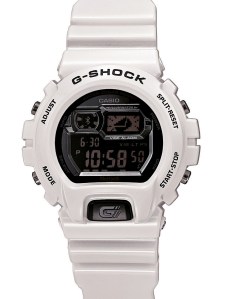
Don’t call it a smart watch. The Casio GB line appeared in 2011 with little fanfare – it was up against devices like the Pebble in the public imagination and so an underpowered smartwatch was of little interest. However, Casio has updated their Bluetooth line with the GB-6900B And GB-X6900B, improved versions of their iconic G-Shock watches that allow you to control your phone from your watch and, more important, control your watch from your phone.

For example, you can do the standard remote control actions on the watch including turning phone audio up and down and seeing snippets of text messages and emails. However, the new Casio Engine 2 movement also allows you to set watch features via an interface on the phone including alarms, stopwatch activation, and the like. Most interesting are the phone sensing features that allows you to find your phone if it is near the watch and to tap the watch to turn off an incoming call.

ABlogTowatch has a full rundown of features and notes that many of these are things you might actually use. While it doesn’t sense your heartbeat, blood pressure, and pants size it does do a few important things well and, more important, connects to your phone via low power Bluetooth profile 4.0. This makes it easier to justify connecting the watch to your phone simply because the battery will wear slower than traditional Bluetooth devices.

Again, the G-Shock isn’t for everybody. However, if you’re looking to geek out you could do worse for $200. The watches should be available here in a few months.

Apple Will Reportedly Unveil The Next iPhone On September 10

It’s about time for a new iPhone, and with the rumors about an iPhone 5S and maybe even a cheaper version getting stronger, AllThingsD now reports that the next iPhone will launch on September 10. Apple introduced the iPhone 5 on September 12, 2012, so there is a good chance AllThingsD’s sources are correct, though we haven’t heard anything from our usual sources yet (and earlier rumors of a June launch definitely didn’t pan out).

Last time around, Apple started taking pre-orders two days after the launch event and the phone went on sale two-and-a-half weeks later.

As far as the iPhone 5S rumors go, most point to an incremental update with the usual speed improvements, thanks to a faster chip, a better camera with a dual LED flash and enhanced battery life. The only really exciting rumor so far is that Apple will introduce a built-in fingerprint reader for unlocking your phone. There are also persistent rumors of a cheaper iPhone 5 — maybe with a plastic back.

Otherwise, iOS 7 will likely be the most controversial feature of the new iPhone, given its radically new design. Unless Apple still has a few aces up its sleeve, iOS 7 isn’t likely to introduce any major new services besides iTunes Radio. While the first betas of iOS 7 were almost unusable, the latest versions are very stable and feel like they are almost ready for prime time.

Apple, of course, is also about to launch OS X Mavericks, but it would be unusual for the company to announce this during an iPhone launch keynote

StartupEquality.org: Remove Restrictions On Gay Investors

Editor’s note: Dan Shapiro served as the CEO of Google Comparison Inc., Sparkbuy, and Ontela. He’s the author of a forthcoming O’Reilly book on startup CEOs and a lucky dad. Follow him on Twitter @danshapiro.

StartupEquality.org has a simple mission, which is to get same-sex couples the same rights to invest in startup companies as heterosexual couples.

My dad received his PhD from Yale for a number of reasons. One of those reasons was that, just a few years before he enrolled, the university removed its Jewish quota. In subsequent years, both of my parents saw the even more egregious restrictions on African-Americans begin to slowly, painfully unravel. Their generation saw a wave sweep from buses to schools to wedding chapels as our nation desegregated.

I never thought I would see anything like this in my lifetime. Seeing America start to untangle, over the course of a few decades, a giant hairball of laws and prejudices and assumptions that have plagued the lives of gay and lesbians has been a singularly amazing experience. States have begun to recognize loving couples. The Supreme Court overturned the Defense of Marriage Act. And I have been watching friends and family I have loved and respected all my life come out to share with me and the world who they really are and who they really love.

Over the last decade particularly, I’ve taken a measure of pride that my community of entrepreneurs and startup investors has been relatively immune to this discrimination. I’ve always believed that the world of technology startups has never erected artificial barriers to those who want to pursue the American dream.

But we’ve got a bug in the code, and it was two lawyers who found it.

My friends Joe Wallin and William Carleton sent me an email out of the blue one day. They told me that they found something amiss with the SEC rules about who is eligible to invest in startups. We all read the rules, and the problem doesn’t look deliberate. It’s just an artifact of changing times and changing rules. But it’s a bad artifact, and we’ve got to set it right.

SEC rules describe something called “accredited investor” status. If you’re not an accredited investor, you are effectively blocked from startup investments. (Under the JOBS Act, small investments may be possible without accreditation, but larger investments — the angels who enable ideas to take wing — will still be restricted.) As a result, these rules around accreditation define who is, and who is not, a part of the startup angel community.

To take an excerpt from these SEC rules: “‘Accredited investor’ shall mean . . . Any natural person whose individual net worth, or joint net worth with that person’s spouse, exceeds $1,000,000.”
These gay and lesbian investors can’t use their partners’ assets or income to qualify as angels. Instead, they must qualify alone, under significantly more restrictive standards.

But we live in strange times. Couples who love each other, who’ve pledged their lives together, who’ve decided to join their resources together for an eternity, do so under more than one name: “marriage”; “civil union”; and “domestic partnership.” By only referring to spouses — which is defined to mean only married couples — the SEC disqualifies couples in civil unions or domestic partnerships in 15 states across the country. That means these gay and lesbian investors can’t use their partners’ assets or income to qualify as angels. Instead, they must qualify alone, under significantly more restrictive standards.

In the future I hope that, as a country, we set a single standard for what it means for couples to love each other, pledge their lives together, and join their resources. I hope that’s called marriage. But until we get there, the SEC needs to fix angel investing.

Startups are not just my industry but my passion. I’m proud of how startups have made this country better. Now it’s time for our country to make startups better. Please join me at StartupEquality.org in calling on the SEC to set this right. Let’s unlock dollars for small companies. Let’s welcome people of all backgrounds to the table. And let’s make startup investing available equally to all couples across America.

10 August 2013

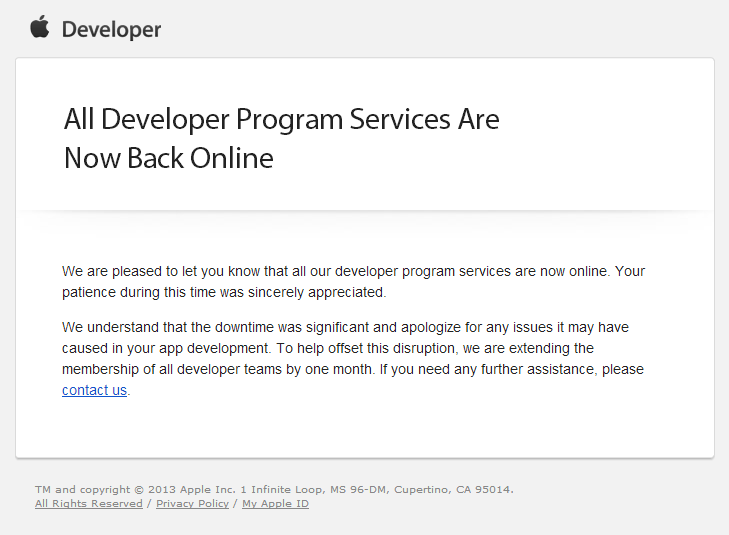
Apple Brings Final Developer Services Back Online, Extends Memberships By 1 Month

Apple today announced that all of its developer program services are now back online. Apple’s portal for developers, which also hosts its iOS and OS X beta downloads, went down on July 18th and a few days after, the company acknowledged that there had been a security breach. To make up for the prolonged outage of some of the services, Apple will extend all memberships, which are usually for a year, by one month.
In typical Apple fashion, the company remained quiet for a while after it took the Developer Center down, but the quickly released a statement and admitted that it had taken the site down because “an intruder attempted to secure personal information of our registered developers from our developer website.” No “sensitive personal information” was accessed, Apple said at the time, but it couldn’t rule out that the intruders had gained access to developers’ names, mailing and email addresses.

It’s never been clear what exactly happened, though as we reported last month, a 25-year-old Turkish security researcher named Ibrahim Balic had just posted a security bug in the developer center a few days earlier.

After shutting the site down completely, Apple brought its services back online in batches, starting with certificates, identifiers and profiles, as well as its developer forums, bug reporter and libraries. It then brought back software downloads, including its iOS 7, OS X Mavericks and Xcode 5 betas and now, it has also restored access program renewals and enrollment, as well as Xcode Automatic Configuration.


Microsoft Doesn’t Want To Admit Windows RT Is Dead

Microsoft is in a tough spot. Windows RT is all but dead in the water. But Microsoft has approximately a zillion and a half Surface RT tablets collecting dust in warehouses. And so Ballmer and Co. continued its ignorant fight against Apple and the far more successful iPad with another TV spot that pits the two against each other.

Spoiler: The Surface RT is declared the winner.

Like in previous commercials, the Surface RT’s legitimate advantages are touted over the iPad and iOS. And in many cases, Microsoft isn’t exactly deceitful. The Surface, and with that, Windows RT, has clear advantages over the iPad. At first blush Windows RT feels more productive and advanced than iOS. But after a couple of swipes left and right on the Start Screen, the novelty wears off.

Of course Microsoft failed to stack Windows RT’s apps against those found in iOS.
Windows RT was a dog from the start. And now that Asus pulled back from the market, the little brother to Windows 8 will quickly fade into irreverence. With Asus out, just Dell and Microsoft remain as the only Windows RT hardware providers. Samsung, HTC, HP, and Lenovo previously pulled plans for a Windows RT tablet.

“It’s not only our opinion,” CEO Jerry Shen remarked to the Wall Street Journal. “The industry sentiment is also that Windows RT has not been successful.”

At this point, with Windows RT’s support quickly drying up, Microsoft is doing consumers a disservice attempting to pawn their unsuccessful tablet onto unsuspecting buyers shopping on specs alone. The Windows RT product segment will soon be dead, and with it, the little developer support it currently has will quickly follow suite, leaving consumers with a tablet that will be stuck in the past.

Why Founders Fail: The Product CEO Paradox

Editor’s note: Ben Horowitz is co-founder and partner of Andreessen Horowitz. He was co-founder and CEO of Opsware (formerly Loudcloud), which was acquired by HP, and ran several product divisions at Netscape. He serves on the board of companies such as Capriza, Foursquare, Jawbone, Lytro, Magnet, NationBuilder, Okta, Rap Genius, SnapLogic, and Tidemark. Follow him on his blog and on


If I knew what I knew in the past
I would have been blacked out on you’re a** —Kanye West, Black Skinhead

Because I am a prominent advocate for founders running their own companies, whenever a founder fails to scale or gets replaced by a professional CEO, people send me lots of emails. What happened, Ben? I thought founders were supposed to be better? Are you going to update your “Why We Prefer Founding CEOs” post?

In response to all of these emails: No, I am not going to rewrite that post, but I will write this post. There are three main reasons why founders fail to run the companies they created:

The founder doesn’t really want to be CEO. Not every inventor wants to run a company and if you don’t really want to be CEO, your chances for success will be exceptionally low. The CEO skill set is incredibly difficult to master, so without a strong desire to do so the founder will fail. If you are a founder who doesn’t want to be CEO, that’s fine, but you should figure that out early and save yourself and everyone else a lot of pain.

The board panics. Sometimes the founder does want to be CEO, but the board sees her making mistakes, panics and replaces her prematurely. This is tragic, but common.

The Product CEO Paradox. Many founders run smack into the Product CEO Paradox, which I explain below.
The Product CEO Paradox

A friend of mine led his company from nothing to over $1 billion in revenue in record time by relentlessly pursuing his product vision. He did so by intimately involving himself in the intricate details of his company’s product planning and execution. This worked brilliantly up to about 500 employees. Then, as the company continued to scale, things started to degenerate. He went from being the visionary product founder who kept cohesion and context across the increasingly complex product line to the seemingly arbitrary decision maker and product bottleneck. This frustrated employees and slowed development. In reaction to that problem and to help the company scale, he backed off and started delegating all the major product decisions and direction to the team. And then he ran smack into the Product CEO Paradox: The only thing that will wreck a company faster than the product CEO being highly engaged in the product is the product CEO disengaging from the product.

This happens all the time. A founder develops a breakthrough idea and starts a company to build it. As originator of the idea, she works tirelessly to bring it to life by involving herself in every detail of the product to ensure that the execution meets the vision. The product succeeds and the company grows. Then somewhere along the line, employees start complaining that the CEO is paying too much attention to what the employees can do better without her and not enough attention to the rest of the company. The board or CEO Coach then advises the founder to “trust her people and delegate.” And then the product loses focus and starts to look like a camel (a horse built by committee). In the meanwhile, it turns out that the CEO was only world-class at the product, so she effectively transformed herself from an excellent, product-oriented CEO into a crappy, general-purpose CEO. Looks like we need a new CEO.

How can we prevent that? It turns out that almost all the great product-oriented founder/CEOs stay involved in the product throughout their careers. Bill Gates sat in every product review at Microsoft until he retired. Larry Ellison still runs the product strategy at Oracle. Steve Jobs famously weighed in on every important product direction at Apple. Mark Zuckerberg drives the product direction at Facebook. How do they do it without blowing their companies to bits?

Over the years, each one of them reduced their level of involvement in any individual set of product decisions, but maintained their essential involvement. The product-oriented CEO’s essential involvement consists of at least the following activities:

Keep and drive the product vision. The CEO does not have to create the entire product vision, but the product-oriented CEO must drive the vision that she chooses. She is the one person who is both in position to see what must be done and to resource it correctly.

Maintain the quality standard. How good must a product be to be good enough? This is an incredibly tough question to answer and it must be consistent and part of the culture. It was easy to see the power of doing this right when Steve Jobs ran Apple, as he drove a standard that created incredible customer loyalty.

Be the integrator. When Larry Page took over as CEO of Google, he spent a huge amount of his time forcing every product group to get to a common user profile and sharing paradigm. Why? Because he had to. It would never have happened without the CEO making it happen. It was nobody else’s top priority.

Make people consider the data they don’t have. In today’s world, product teams have access to an unprecedented set of data on the products that they’ve built. Left to themselves, they will optimize the product around the data they have. But what of the data they don’t have? What about the products and features that need to be built that the customers can’t imagine? Who will make that a priority? The CEO.

But how do you do that and only that if you have been involved in the product at a much deeper level the whole way? How do you back off gracefully in general without backing off at all in some areas? At some point, you must formally structure your product involvement. You must transition from your intimately involved motion to a process that enables you to make your contribution without disempowering your team or driving them bananas. The exact process depends on you, your strengths, your work style and your personality, but will usually benefit from these elements:

Write it; don’t say it. If there is something that you want in the products, then write it out completely. Not as a quick email, but as a formal document. This will maximize clarity while serving to limit your involvement to those things that you have thought all the way through.

Formalize and attend product reviews. If teams know that they should expect a regular review where you will check the consistency with the vision, the quality of the design, the progress against their integration goals, etc., it will feel much less disempowering than if you change their direction in the hallway.

Don’t communicate direction outside of your formal mechanisms. It’s fine and necessary to continue to talk to individual engineers and product managers in an ad hoc fashion, because you need to continually update your understanding of what’s going on. But resist the attempt to jump in and give direction in these scenarios. Only give direction via a formal communication channel like the ones described above.

Note that it is really difficult to back off of any non-essential involvement yet remain engaged where you are needed. This is where most people blow themselves up: either by not letting go or by letting go. If you find yourself where my friend found himself — you cannot let go a little without letting go entirely — then you probably should consider a CEO change. But don’t do that. Learn how to do this

Surface RT 2: Tegra confirmed, despite superiority of Snapdragon and Bay Trail

Despite the Surface RT’s miserable performance, and almost every other tablet maker jumping ship to Qualcomm, it appears that the Surface RT 2 — due out in October alongside Windows 8.1 — will still be powered by Nvidia’s Tegra SoC. With Intel’s Bay Trail due to hit the market at around the same time, and potentially offering more performance than the ARM-based Tegra 4, does the second-generation Surface RT really stand a chance?

Curiously, this information comes directly from Nvidia’s CEO, despite the fact that Microsoft hasn’t yet officially announced the Surface RT’s successor. “We’re working really hard on it,” CEO Jen-Hsun Huang told CNET. Huang also mentions that the original Surface RT came bundled with Office RT, but it lacked Outlook. With the next version of Windows RT, based on Windows 8.1, Outlook is included. “[Outlook] is the killer app for Windows. Now we’re going to bring it with the second-generation Surface.”

This news comes shortly after we learnt about the true extent of how poorly the Surface RT and Pro tablets have performed in the market. Microsoft has millions of unsold Surface RT tablets sitting in a warehouse somewhere, and the Pro hasn’t done much better. There are numerous theories that try to explain why Microsoft’s first attempt at first-party tablets has gone so poorly, but when it comes to the Surface RT, it’s clearly a combination of just two major factors: Sluggish performance, thanks to the Tegra 3 SoC; and atrocious marketing and communication about the capabilities of Windows RT. Why, then, is Microsoft going with Tegra again, when almost every other mobile device maker has shifted to Qualcomm?
Nvidia Shield main logic board, with the Tegra 4 Soc (orange)

Now, presumably, the Surface RT 2 will use a Tegra 4 SoC. Tegra 4 won’t have the same performance concerns as Tegra 3, but the jury is still very much out on whether the hot-and-hungry Cortex-A15 CPU cores in the Tegra 4 can compete with Qualcomm’s Krait CPUs without draining the battery dry. Nvidia had lined up quite a few Tegra 4 design wins, but due to delays and other concerns, it seems like the company’s own Shield and the Surface RT 2 won’t have many cousins at all. In short, there is a reason why almost every smartphone and tablet announced in the last few months has been powered by a Qualcomm Snapdragon 600 or 800 SoC.

Which leads us neatly onto another rumor that Qualcomm will actually provide SoCs for “some versions” of the Surface RT, but not all of them. We have known for some time that Microsoft would like to release a smaller (7- or 8-inch) Surface. Nvidia’s comments clearly indicate that Tegra will be in the “second-generation” Surface, which presumably means that Snapdragon will be used in the new, smaller version. With Snapdragon consuming less power than Tegra 4, this makes some sense. With Intel’s Bay Trail coming to market, though, and promising a performance-per-watt ratio comparable to ARM, it will be very interesting to see if the Tegra 4-based Surface RT is even worth buying.

In other news, Asus this morning said it had pulled out of Windows RT entirely, and will now solely produce Windows 8 tablets based on x86 processors. Windows 8.1 will rectify some of Windows RT’s issues, but it still has some fundamental flaws that will continue to hamper its success as a tablet OS.

Amazon might throw its hat in the ring with an Android-based gaming console

2013 is already filled to the brim with console launches, but it seems as if we’re in for at least one additional competitor in the fourth quarter. Rumors now point towards Amazon launching an Android-based game console by the end of the year, and the few details we have sound surprisingly compelling. While the world definitely doesn’t need yet another half-hearted Android gaming device, this could be Amazon’s big move towards launching a full-fledged set-top box to compete with the likes of Apple TV and Roku.

This week, unidentified sources told Game Informer that Amazon has plans to bring out its Android-based console in time for Black Friday — the kick-off to the holiday shopping season in the United States. While we don’t have any information about the potential horsepower, controls, app compatibility, or price, the rumor mill is already cranking out ideas for this theoretical Amazon console.

While Android-based consoles like the Ouya or GameStick haven’t exactly set the gaming world on fire, Amazon is a company that has the money and business relationships to potentially execute on this idea properly. Since the Seattle-based company already has a successful hardware and software division in place for the Kindle Fire, it’s plausible that Amazon can pull off something compelling despite the lukewarm response to these Kickstarted consoles.
Interestingly, this rumored hardware could end up being much more than a low-cost gaming novelty. Instead of a boring machine designed just to play Angry Birds, this might actually serve as Amazon’s stealthy entry into the world of set-top boxes. As small WiFi-enabled boxes like the Apple TV and Chromecast continue to grow in popularity, it would be no surprise to see Amazon wanting a piece of that pie. With a full-fledged library of movies, TV shows, music, and apps ready for streaming, a cheap Amazon-branded set-top box in the style of the Kindle Fire tablets is a no-brainer.

Even if this rumored console has no hope in competing head-to-head with the PS4 and Xbox One, Amazon is clearly focused on becoming a top-tier hardware and media provider. With Google’s continued television fumblings, and Apple’s recent legal issues surrounding its business practices, Amazon is primed to take a substantial bite out of the market. Unfortunately, now we have to sit and wait to see if it can actually execute on something worthwhile.

ET deals: $599 Core i5-powered Dell 15R laptop

We seem to be in the midst of a last-gen close out bonanza from Dell. Here’s a prime example: this deal will net you a 1080p laptop with discrete graphics, backlit keyboard, and a ton of other goodies for $600.

Most of us power users are in love with high res screens. With 1080p resolution on a 15.6-inch LCD, the Inspiron 15R Special Edition has a great screen for multi-taskers and media consumption. Unfortunately with most systems you only get the 1080p screen when all the other expensive goodies are tacked on, like the Core i7 processor that tends to add a few hundred dollars to the price tag
This configuration combines all those high-end features with a dual-core 3rd gen Core i5 processor, which has plenty of performance for even the demanding users while keeping the price down. Along with this is the aforementioned 1080p screen, 2GB Radeon HD 7730M graphics, 6GB of RAM, and a 750GB hard drive, making for a well equipped machine at this price point.

You won’t want for any extra ports or connectivity between the four USB 3.0 ports, ethernet, HDMI, VGA, media card reader, HD webcam, 802.11n WiFi, and Bluetooth 4.0. All of this is packed into a very attractive black anodized aluminum chassis.

Wrapping up this tech-filled machine is a one-year warranty that includes in-home service, something we don’t see from any other manufacturer. This is the lowest price we’ve ever seen on this machine, but you’ll have to hurry before this model disappears forever.

Click here to start at Dell.com. Apply coupon code 3J836$$3GHW127 for total $300 savings. This deal ends 8/14 or sooner.

Mystery of 600,000 light-year-long gas stream solved by Hubble

Our Milky Way galaxy doesn’t just hover in space all by itself. There are a number of small satellite galaxies orbiting it like moons around a planet. Two of these galaxies, the Large and Small Magellanic Clouds, have been at the heart of an astronomical mystery for the last 50 years. It was 1965 when scientists discovered a massive stream of gas extending from these two galaxies, but were at a loss to explain its formation. Massive doesn’t actually do the so-called Magellanic Stream justice — it wraps itself halfway around the Milky Way, and is a staggering 600,000 light years long.

Astronomers have posited a variety of hypothesis to explain the presence of such a gigantic cloud of gas trailing off from two small galaxies in the decades since its discovery. Most of these scenarios had the Magellanic Stream forming all at once, possibly as the result of some gravitational interaction between the Small Magellanic Cloud and the Milky Way. It took detailed observation by the Hubble Space Telescope to figure it out.

A team of astronomers, led by Andrew J. Fox of the Space Telescope Science Institute in Baltimore, used Hubble to gather data indicating that the Magellanic Stream is composed of material from both the Large and Small Magellanic clouds (the bright spots in the image above). Perhaps more unexpectedly, it was stripped from the dwarf galaxies at different times.

The astronomers made their observations of the Magellanic Stream by pointing Hubble at quasars — the super-bright active cores of distant galaxies. These were used to backlight the cloud and allowed a precise absorbance spectrum to be gathered. The levels of oxygen and sulfur in different parts of the stream gave researchers the data to pinpoint the age and origin of the gas.

We now know the stream initially formed more than two billion years ago when a stream of matter was ripped from the Small Magellanic Cloud. The part of the gaseous ribbon closer to the dwarf galaxies had a different profile, though. The team concluded that it matched the composition of the Large Magellanic Cloud, which means that part of the stream was formed more recently.

The new research also clarifies the mechanism of formation. As the satellite galaxies are pulled closer to the Milky Way they encounter the halo of hot gas around it, which displaces the gas native to the Magellanic Clouds. The stream is the result of that effect combined with the gravitational tug-of-war between the two smaller galaxies. The displaced gas is simply catapulted off in a gravitational slingshot.
A great deal of effort has been devoted to understanding the Magellanic Stream and the Clouds that produced it. The Large and Small Magellanic Clouds are unique among the Milky Way’s satellite galaxies because they have been able to retain most of their gas envelopes and are still actively forming stars. Without the presence of sufficiently dense gas clouds, star formation stops. This is what we see in most nearby dwarf galaxies, and it gives us a preview of what will one day happen in the Milky Way.

The gas stripped away in the Magellanic Stream is slowly spiraling in toward the Milky Way, and could kick off a wave of new star formation when it gets here. The team believes the stream could get even larger if another puff of gas from the Large or Small Magellanic Cloud were to be thrown off. Even if 600,000 light years is all the longer this stream of star-birthing gas gets, it’s going to be a bright future for our galaxy.


Now read: The giant black hole at the center of the Milky Way is murdering a huge gas cloud

Xbox Live Family Plans get converted to individual memberships starting August 27th

Microsoft just detailed how the Xbox One's "Home Gold" will spread the Xbox Live Gold love across multiple users of a particular system, but what about those with the current generation's Xbox Live Family Plan? The folks in Redmond stopped accepting new subscribers to the $99 / year package back in March, and now users are receiving an email (included after the break) with details about what happens next. First, the good news: As of August 27th, if you have the family plan then each one of your activated subaccounts get full Xbox Live Gold status for the duration of your remaining subscription, plus three extra months. Prior to the conversion, you can still add sub accounts to the maximum total of four, and if you're set to auto-renew prior to conversion then that will still happen. The conversion may not happen exactly on that date, but subscribers can expect another email a week before it actually occurs.

Now the downsides: Activity reports and Microsoft Points allowances are going away, with reports disappearing at the time of conversion and the latter with the next system update. Another issue will apply to those who used it to game on multiple consoles in or across multiple households, since they'll need multiple individual XBL Gold subscriptions to do so -- one of the big problems the Family Pack resolved when it launched back in 2010. That could make sticking with the Xbox 360 or upgrading to an Xbox One more expensive going forward, check out the FAQ for all the details and run the numbers for yourself.

[Thanks, Corey]


Xbox Live Gold Family Pack Conversion to Individual Memberships

As a valued Xbox Live Gold member, we'd like to thank you and your family for being part of the Gold community.

We continually evaluate our offerings and are always working to provide services that best meet the needs of our customers.

Starting August 27, 2013, we will be converting each activated account on your Gold Family Pack to an individual Xbox Live Gold membership to prepare for new upcoming features on Xbox Live Gold. Rest assured, each individual membership will work on both Xbox 360 and Xbox One.

Through the new Home Gold feature on Xbox One, a single Xbox Live Gold membership will allow anyone in your home to enjoy many Gold features like multiplayer, access to Gold entertainment apps, and more on your Xbox One.*

As a bonus, we will give each converted individual Xbox Live Gold membership from your Gold Family Pack an extra 3 months of Gold (in addition to the time remaining on your membership term).**

Before your memberships convert, you can still add family members to your Xbox Live Gold Family Pack, for a total of up to four accounts. However, any unassigned secondary accounts will no longer be accessible after your conversion. Please be sure to update your secondary accounts here.
After your memberships convert, the only Gold Family Pack features that will no longer be available are activity monitoring reports and Microsoft Points allowances. Activity monitoring reports will deactivate at the time of Gold Family Pack conversion, whereas the Microsoft Points allowance feature will no longer be available after the next Xbox 360 system update. Xbox Live family settings, including parental controls for what your kids can access and play on or offline, will still be available.

We hope you enjoy your 3 bonus months of Xbox Live Gold and continue to benefit from your Xbox Live Gold memberships on Xbox 360 and Xbox One.

Google loads up non-assertion pledge with 79 more patents

In an attempt to live up to its age-old motto to not be evil, Google has just added 79 more patents to its Open Patent Non-Assertion (OPN) Pledge. Enacted in March of this year, the pact was designed to encourage open-source software development, and consists of patents the Mountain View company won't use to sue anyone unless first attacked. While the first set of patents had to deal with large data sets, these additional ones were acquired from IBM and CA Technologies and consist of software used to run data centers, such as middleware and distributed database management. The technologies included in the OPN Pledge has so far been of the back-end variety, but the search giant claims that it'll add more consumer-facing patents to the pledge in the future. Google might not ever be completely free from the dark side, but gestures like these could go a long way in earning good will -- especially in an age of heavy back-to-back lawsuits. For those who want to delve head-first into the legalese, hit up the patent link below

 
Please Click A Facebook "Like" Button