13 August 2013

Hackermeter Wants To Kill Your Résumé And Replace It With A High Score


If you’re looking to hire a bad-ass programmer, fielding résumés can start to feel like an exercise in futility. They’re good for quickly filtering out folks who are clearly applying to everything — but when everyone in the industry has some crazy made-up senior ninja/rockstar/space cadet title, when everyone considers themselves a coder, and when “Proficient with C” can mean two entirely different things based on a person’s ego, that’s about all they’re good for.

Hackermeter, part of the most recent Y Combinator class, thinks they have a better alternative: a coder score.

Hackermeter is based around the concept of coding challenges. The better you perform on each challenge, the higher your score. The higher your score, the more enticing you’ll be to a potential employer.

When you first sign up for Hackermeter, you’re given the choice: developer or employer?

As a developer, Hackermeter initially presents itself as a set of around a dozen challenges for you to pick from. On one end, you’ve got your basics: can you make a fibonacci sequence generator? Can you determine if a string is a palindrome? On the other end, you’ve got the tougher stuff: can you recursively parse a chunk of JSON to look for a very specific type of data structure? Can you test for limitations in a lightweight cryptography model?
Each challenge can be completed in one of five languages: Ruby, Python, Java, C++, or C. You type and test your code right in the browser (more on that in a second), submitting it once you feel it’s up to snuff. Once you’ve submitted a code sample that successfully tackles the challenge at hand, it goes in your portfolio, and your score changes accordingly.

As an employer, you’re able to search through the coders in Hackermeter’s database, with Hackermeter attempting to automatically pair you with developers best suited for a job. Looking for a hard-core Python expert? Filter your search to those who’ve completed the harder challenges using Python. Want an entry-level Rubyist? Disable the difficulty filter, flip on the Ruby filter, and you’ve got your list. Once you’ve found a few coders who fit the bill, you can send them messages — or, if you’re still not quite sure about their coding talents, send them a “screening.”
Screenings are sets of custom-built, rapid-fire coding challenges built by each employer. You can use Hackermeter’s pre-provided challenges, or build your own. You set the time limit, determine how many challenges (if any) can be skipped, then fire your screening off to those you’re interested in hiring.

The most obvious issue, of course, is… well, Google. If you can write a test, someone else can put the answers up online. Ta-da! With a pinch full of the Googles and a fistful of copy/paste, everyone is an expert.

But remember when I mentioned that you’re expected to write your code through Hackermeter’s built-in code editor? That’s why. Employers can play back your coding, keystroke-by-keystroke. If you dump the correct answer to the challenge into the editor in one swift paste, it’d be pretty obvious that you looked it up (or, more innocently, that you wrote it all up in your editor of choice — but you’re not supposed to be doing that.) A bit creepy? Sure — but it’s not really all that different from the live code interviews that most big companies do anyway.

At this point, I’ve got two main gripes with the site:
Lack of coder personality: As it currently sits, the site pretty much boils people down to a name and a score. Efficient? Sure. But also kind of depressing. They could combat this a bit by letting developers provide details about who they are, and what they’re like — maybe a two-minute video introduction? Why not let developers say “Hey! While you’re here, look at this other awesome stuff I’ve built!” While they’ll almost certainly add stuff like this as the site gets built out, it’s not there yet.
Lack of transparency: Once you’ve completed a challenge and get your score, it’s quite tough to tell why you got that score. There’s not much, if any, feedback. Hackermeter co-founder Lucas Baker tells me that it’s based on how long it took you to write the code, how efficiently the code performed, and how hard the challenge itself was. While he says that they’re working on making score explanations a bit clearer, it’s a bit of a black box right now.

Will Hackermeter kill off the résumé, or otherwise turn the entire coder-hiring process upside down? Probably not —effective or not, résumés are an institutional building block, the heartbeat of a billion HR departments (and beyond the résumé, the best coders are often hired through very well-paid referrals and cut-throat poaching). But it’s an interesting approach, and with good developers being harder and harder to find — and more expensive to hire — every day, one that I’d imagine many companies would be willing to try. And if you’re a developer who can’t find a job, putting your face and skill set in front of more employers is never a bad thing.

Google’s Bug Bounty Program Has Now Paid Out Over $2M, Increases Some Chromium Rewards To $5K


Google’s bug bounty program, the company today announced, has now paid out more than $2 million to security researchers. Since the program launched three years ago, the company rewarded researchers for reporting more than 2,000 security bugs in Chromium and its web apps. About $1 million of this prize money went to researchers who reported Chromium-related issues and the other million to researchers who looked into its web apps.

With today’s announcement, the company is also significantly raising the reward for some reports. “Bugs previously rewarded at the $1,000 level will now be considered for reward at up to $5,000,” Google’s “masters of coin” Chris Evans and Adam Mein write in today’s announcement. More significant threats, of course, come with higher rewards (up to $10,000), and Google decided these on a case-by-case basis. Researchers who provide a patch with their bug reports, for example, are eligible for additional rewards.

Today’s announcement followed a similar increase in its web vulnerability program, which now pays $7,500 for cross-site scripting bugs and $5,000 for Gmail and Google Wallet bugs, as well as authentication bypasses. The basic reward level for web app bugs is $3,133.70 (up from $500)

There is clearly some money in reporting bugs. Facebook just made a similar announcement a week ago. The social network says its Bug Bounty program has now paid out more than $1 million. Microsoft, which had long resisted the idea of a security bounty program, recently gave in and launched its own (with bounties of up to $100,000).

Elon Musk’s Hyperloop Explained: A Technically Possible Sci-Fi Dream He’s Too Busy To Work On Right Now

Elon Musk, the extravagant entrepreneur know for his futurey projects, has explained his Hyperloop project to Businessweek’s Ashlee Vance ahead of publishing his blog post and holding his press conference today. It’s an ambitious project that borders on the crazy. This is the guy who built Tesla Motors and SpaceX, but he actually says he regrets bringing Hyperloop up to begin with and says it’s up to someone else to build it.

“I wish I had not mentioned it,” he’s quoted as saying in the Businessweek article. “I still have to run SpaceX and Tesla, and it’s fucking hard.”
The Hyperloop does indeed sound hard, and expensive, but it’s the alternative to a $70 billion high-speed rail plan that’s been widely criticized already, and that one’s going into production. The Hyperloop features tubes with a low level of pressurization that would contain pods with skis made of the SpaceX alloy inconel, which is designed to withstand high pressure and heat. Air exiting those skis through tiny holes would create an air cushion on which the pods would ride, and they’d be propelled by air jet inlets. And all of that would cost only around $6 billion, according to Musk.
Musk’s project has a number of advantages over the current high-speed rail plan in terms of economics, and it’s meant to be built above ground on pylons that mean it wouldn’t require purchasing of huge tracts of land or uprooting of farms and other infrastructure. It also eliminates ambient noise problems, Musk says in his detailed plans, and minimizes derailment risks. It’s also self-powered thanks to solar panels placed along the top of the pod-containing tube’s length. One potential sour note: Musk says in his prospectus that security checks akin to those made by the TSA at airports would be de rigueur for Hyperloop travel.
I’m not going to try to pin down the physics; Businessweek does a great job explaining it, and they’ve spoken to a preeminent physicist who says it’s all feasible (and adds it would be “cool” if the tubes were transparent). Perhaps the best summary of it all is what Valleywag’s Sam Biddle has to say about it on Twitter:

https://twitter.com/samfbiddle/status/367022858465054721

Musk’s official blog post on the subject is live now on his blog (direct link to the detailed PDF prospectus, which will apparently be updated soon with correction), and it’s also meaty reading. On a conference call describing the system, Musk did say that he wanted to at least create a small-scale demonstration prototype to hand off to someone else. But the bottom line is that Musk came up with something that he has no intention to build, and that sounds incredibly hard to build, and will probably remain firmly imaginary. Fun.

In Wake Of Teen Suicides, Ask.fm Faces A “Myspace” Problem

The teenage brain is not fully developed, say scientists. Specifically, the part of the brain called the frontal lobe, which houses judgment, insight, dampening of emotions, and impulse control. This is relevant in a discussion about building companies that target young adults, especially if those sites are social media outlets where users are allowed to participate anonymously, share positive and negative feelings, react to posts made by others, and otherwise quickly publicize any idle thought that comes to mind.

And we need to have this discussion, calmly and rationally, because it’s clear social media websites play some role in pushing those susceptible to depression, self-harm and suicidal thoughts to take desperate measures.

We need to address this situation, but not with the goal of blaming the Internet or social media or individual outlets, or sometimes even the bullies who can often just be children, too, making mistakes of their own. We need to think about: whether sites that ignore these problems can be sustainable businesses; whether there are ways to do things differently; and whether we could do more to help children left to wander throughout the web — and all its good and bad parts — quite so alone.
Ask.fm As The New MySpace: Getting Blamed For Teen Suicides
The latest example, and current Internet whipping boy, is Ask.fm. The wildly popular service among teens (and those even younger who lie about their ages), is being blamed by the parents of 14-year old Hannah Smith who recently took her own life after receiving abusive messages from other users on the site: “drink bleach”; “go get cancer”; and “go die” among other things
Sadly, Hannah’s suicide is one of many suicides linked to Ask.fm as a result of being bullied by other Ask.fm users — typically children whom the suicide victims know.

In December, 16-year old Floridian Jessica Laney was found dead in her home after bullying on Ask.fm — one commenter had even asked “can you kill yourself already?” Others had called her “fat” and “a loser.” Fifteen-year-old Ciara Pugsley of Dromahair, Ireland, who played sports and loved her pony Basil, was taunted by anonymous posters on the site who called her “slut” and “ugly.” She took her own life in September 2012. 15-year old Canadian teen Amanda Todd committed suicide in October, after online and offline bullying, and blackmail over inappropriate photos. 13-year old Erin Gallagher, who faced vicious bullying about her weight and looks, committed suicide the next month. Then her sister Shannon, who missed Erin deeply, also took her life in December 2012, extending that family’s personal tragedy.

Each news outlet retold these families’ personal devastations as cyberbullying cautionary tales, and Ask.fm as the enabler.
Our hearts break for these teens and their families, and in the wake of tragedies like this, humans have an instinctual need to place blame. But is Ask.fm at fault, and if so, to what extent?
Two Schools Of Thought

There are two arguments that can be made regarding Ask.fm’s situation. One, of course, is that the site could and should do more: more moderators, more reporting tools, more site-wide user bans. Less anonymous trolling.

At the very least, anonymity should not be the default, says Patti Agatston, Ph.D. and co-author of Cyber Bullying: Bullying in the Digital Age. “Sites that offer the opportunity for anonymous queries should not be anonymous by default, but rather should allow questions and comments with identities shown by default. A user would have to actively change their default preferences if he or she wishes to allow anonymous questioning,” she says. “This would offer some protection for vulnerable youth since such sites typically allow users as young as 13.
However, Agatston adds that shutting down Ask.fm wouldn’t solve any problems, as other sites will pop up to take its place. What we really need to do is better educate children about how to navigate social media, as well as social situations offline.

The other argument is that the site does provide adequate controls: The ability to accept anonymous questions can be switched off; questions aren’t published unless a user chooses to answer; and it offers a “report” button where users can report abuse to moderators. Plus, this argument continues, those at blame for the fallout from cyberbullying are the bullies themselves and not the platforms where the bullying occurs.

The Financial Impact Of Cyberbullying On Business

The Ask.fm problem is not at all new. It is not the first, and certainly not the largest, platform to deal with challenges of bad behavior online and the consequences — sometimes quite tragic — it entails. Those with longer memories may remember another prominent social network that once faced the same finger-pointing that Ask.fm now does: Myspace.

This network, too, became known for teen suicides, particularly for the bizarre case where a rival teen’s mom actually did the bullying. Eventually, the panic around cyberbullying, investigations into sexual assaults linked to Myspace users, and high-profile decrees from then Connecticut Attorney General Richard Blumenthal to improve safety standards on the site damaged the site’s reputation. And as the perception of Myspace changed, so did the business. Newcomers Twitter and Facebook targeted Myspace users looking for an out (Facebook with richer privacy tools) as advertisers fled.
News coverage helped spread the message that Myspace was a dangerous place for kids, and Myspace had to turn its efforts toward user safety and away from innovation. More importantly, it lost its “cool” factor. The crowd moved on, and Myspace fell into decline. Today, it lingers on, seemingly only as a way to boost Justin Timberlake’s record sales.

The stain of association became too difficult to remove for Myspace. And now Ask.fm is riding out a similar trajectory with a financial impact of its own: Advertisers have been pulling out, including Save the Children (which is leading a boycott), eBay, Vodafone and BT.

Ask.fm may not be any more to blame than Myspace was, or user forums and bulletin boards were in the pre-social media days. But it is increasingly being perceived as the new dangerous playground for children, and it’s facing a crossroads all the same: Clamp down on the free-for-all and risk losing the fickle teens now fueling the site’s meteoric growth, or continue as is, even if the reputation — and revenue possibilities — suffer?
Doing Things Differently
Perhaps a better idea, if one that may come too late for Ask.fm, is to have the foresight to think about these kinds of problems before launching a new social network. One service that has taken this approach is newcomer Whisper, a mobile social network for sharing secrets. The service looks a lot like the online website PostSecret, except that users can socialize around the confessions — yes, even anonymously.
The difference is that Whisper takes its role seriously in enabling a younger, perhaps sometimes even emotionally fragile, audience to have productive and positive discussions about their issues. The service quickly bans accounts in violation of its community policies around abuse. Co-founder Michael Heyward estimates that trolling content is gone in less than a minute and a half, in fact. In addition, the company is associated with a nonprofit organization which it refers to those who post suggestive or “triggering” thoughts, specifically if they’re sharing messages related to self-harm, such as suicide.

Heyward recently explained his position on these, saying that a lot of those building social media sites are unwilling to make short-term sacrifices for long-term viability of the business. The services then become addicted to the traffic, he says, the story of Myspace’s fall from grace fresh on his mind. “They’re not willing to do anything that even remotely alienates a small amount of the audience, or that’s going to affect their daily numbers.”

That statement could also be a subtle jab at Ask.fm, which has benefitted from the Wild West nature of its service, where very little safety info is provided, and policies around prohibiting abuse (“Anonymity should never be used to ask questions that are mean or hurtful“) are obviously not enforced. But Ask.fm’s CEO and founder Ilja Terebin seems more caught off-guard by the fallout as of late, rather than more deviously hoping to profit from the free-for-all, teen-angst-fueled drama. “We understand we have to be responsible for our users,” he recently told TechCrunch, but admitted he didn’t know what he could have done differently. He upheld his belief that Ask.fm has done nothing wrong.

The company is now on PR lockdown.
Humans seem to operate better when things can be neatly placed into boxes and viewed in black and white, but the issue of cyberbullying, self-harm, teen suicide, and social networking sites’ role in all that is not one where answers come easily. But we do need to acknowledge that, of all the social media users out there, children and teens are the least able to think through the potential consequences of their actions, which does perhaps place some responsibility on platform makers to have moderation, abuse reporting (yes, you too, Twitter) and content policies in place — especially when anonymity is an option.

And maybe before the next Twitter, or Myspace, or Ask.fm comes along, the founders could take a minute to ponder whether or not there’s a better way to do this. One where user safety can be built in from the start, without losing the cool factor that draws users — and often the very young — to its service in the first place.

Windows Azure Adds New Features, Including SQL Server Support General Availability And New Push Features


Microsoft introduced a laundry list of new features today for Windows Azure, including general availability of SQL Server AlwaysOn support, notification hubs and autoscale improvements.

The new features have some common themes, focusing on systems automation that allows for use cases such as with Bing, which is using Azure notifications to send news updates to its users.

SQL Server AlwaysOn Availability is the high availability and disaster recovery that was originally released with SQL Server 2012. It provides multiple database failover, replicas and configuration failover policies. As part of general availability, Azure now supports “the complete SQL Server AlwaysOn Availability Groups technology stack with Windows Azure Virtual Machines – including enabling support for SQL Server Availability Group Listeners. “

Also available are replicas for backup to assure global availability and disaster recovery. In that vein, Azure is offering on-premise SQL servers that can now be backed up in Windows Azure. So if there is a failover at the data center, Azure can back it up to keep things running smoothly.

The notifications features as part of this release are primarily designed for mobile app developers who send simultaneous push notifications in a low-latency way with the ability to handle localization, multiple platform devices, and user personalization. The Bing news app is using the notification feature to send out news updates.

The Windows Azure team is also offering new autoscaling features such as scheduled rules to optimize performance and cost.

This is a huge release. I’d recommend reading Scott Guthrie’s full post, linked above, to get a detailed picture of what Windows Azure is offering with this latest update.

Feature updates have become a weekly occurrence for Windows Azure over the past several months. putting them on par with Amazon Web Services and Google in terms of improvements to their respective cloud infrastructures.

Stantt Uses Body-Scan Data To Create A Shirt For Every Body Type

Clothing brands have begun using body-scan data to tweak their clothing sizes and to help customers find the right fit. But a new Kickstarter campaign is taking this method further by creating sizes from the ground up. With 50 different sizes modeled after body scans, Stantt wants to provide a quick and cheap alternative to custom-tailored clothing.

Stantt founder Matt Hornbuckle started by scanning the bodies of more than 1,000 men ranging in age from 25 to 35. Each scan was composed of about 200 body measurements. He narrowed these down to three main measurements that would determine how well a shirt would fit: chest width, waist width and arm length. Using the data collected, Hornbuckle created each new size from digital models of various body builds.

Right now, several stores use personal body scans to find or manufacture a size. The difference with Stantt is it uses already collected data to predict potential body types. Instead of taking your own body scan, you can measure yourself at home and enter in the three numbers. Stantt also already has sizes constructed based on these measurements, so you won’t need to wait for the actual production of the shirt. To order a Stantt shirt, customers enter their measurements, and the corresponding size will ship right away.

After comparing his data to popular brands, Hornbuckle says he found that standard small, medium and large sizes only fit about 15 percent of men. But Stantt isn’t looking to take on large consumer brands.

“If you look at some of the big stores out there where a lot of guys shop, their casual shirts have 50 different styles, with six to seven sizes, and those numbers add up in a big way.” Hornbuckle tells me. “What we’re focusing on is a line of being really simple and straightforward. We’re going to focus on just the essentials.”
Hornbuckle also faces competition from startups who are making custom-tailored clothing much more accessible and affordable. For example, Trumaker sends “outfitters” to take 12 personal measurements, determine the right size and deliver a custom-made shirt. Another company, Vastrm, makes custom-fitted polo shirts, based on height, weight, body type and waist size. After trying on some sample shirts, you can tweak the fit online and then start ordering.

Both these options are able to offer more styles and customization options for cuffs, pockets, colors and more. But they also take time and effort to finesse the fit. Hornbuckle says his solution makes shopping easier for men, with measurements they can take themselves and no waiting for clothes to be custom manufactured.

Hornbuckle says he recognizes that supplying shirts in 50 different sizes to ship immediately is a lot of hassle for production. That’s why he is starting the Kickstarter off with five simple options: a standard button-down shirt for $98 in three colors and a polo shirt for $68 in two.

Stantt is planning to offer other styles and garments based on demand. You can check out their

Anthony Weiner Has No Idea Why He Didn’t Use Snapchat Either


Today during a BuzzFeed Brews session with Ben Smith, New York mayoral candidate Anthony Weiner was asked why he didn’t use Snapchat during his infamous sexting campaign with half the single women of the United States.

His answer will rest immortal: “I don’t have a good answer to that.”

It isn’t clear whether Weiner is simply unaware of what Snapchat is, or whether he feels foolish that we have all seen so much of his genitalia, and that it could have been avoided with a simple app download.

Then again, Carlos Danger ain’t afraid of no digital paper trail. And where’s the fun in knowing you won’t get caught, right?

Unless Snapchat doesn’t, you know, delete all that shit.

As soon as we have the clip, we’ll post it here.

(Alexia has some sort of conflict of interest with this post that I don’t care about.)

Top Image Credit: Max Talbot-Minkin

CloudZync, (Yet) Another M-Payments Startup, Launches In London With 280 Retailers Willing To Give Its Wallet App A Go


There’s no shortage of ways to pay for stuff involving a mobile phone, even if most people still reach for the coin in their pocket — rather than trying to grapple with NFC or pay-by-SMS or scan a QR code or use a mobile wallet app or stick their bank/credit card in someone else’s mobile card reader or let a retailer snap your photo. The future of money is a pretty flavourful place already and it hasn’t even properly arrived yet. In all this noise one thing’s for sure: more entrants and experimentation are inevitable before some kind of order emerges.

Case in point: today another mobile payments player has elbowed in. U.K. startup CloudZync, founded in June last year, has just launched a wallet app called Zync Wallet (on iOS and Windows Phone, with an Android app due later this year) that seeks to combine preloaded mobile payments with in-app loyalty schemes and a messaging space for customers and merchants to share info with each other — e.g. stuff like discounts and offers, from the merchant’s side, and details of a favourite drink or sandwich, from the customer’s.

CloudZync co-founder and CTO, Andrew Smith, tells TechCrunch the problem this latest mobile payments startup is trying to fix is that existing payments systems aren’t actually broken — hence retailers’ sloth in adopting the various newfangled m-payments offerings. CloudZync’s premise is that a mobile payments offering therefore needs to more than just a conduit for payments in order to make it compelling enough for retailers to get behind it. It’s not the only m-payments startup thinking along those lines — another that springs to mind is Placecast’s ShopAlerts Wallet. And of course Apple added a loyalty scheme/mobile ticketing hub to iOS last year with its Passbook feature (fully-fledged mobile payments not included, however).

Smith said CloudZync has spent a lot of time over the past year talking to merchants, small and large, about what they want from “mobile technologies”, broadening the query beyond just payments. The resulting app is, he says, a “personal communications channel” between customer and merchant which also offers a payment facility — by allowing consumers to pre-load money onto their Zync Wallet which can be spent later via the app.

“The payments industry already works… I can quite easily pay with cash, I can pay with cards as they are, so mobile really needs to be an evolution of payments — add extra value to that particular process. Just being able to pay on a mobile phone isn’t enough,” he says. “Because of this we started to look at the different things that are important to a business at the point of check-out — such as deals, such as personalised deals, such as loyalty schemes.”

The app includes a personalised pinboard where merchants’ deals, vouchers and messages can be displayed to customers. CloudZync’s merchants’ service also includes a white label loyalty scheme so retailers can set up, brand and manage their own loyalty scheme within the app.

How does Zync Wallet work for consumers wanting to make payments? The app is unlocked with a PIN code, and the user then selects an option to make a payment, which brings up a QR code for the retailer to scan. The retailer of course needs to be using the corresponding merchants’ Zync Wallet terminal app to accept payments. This app allows them to verify the buyer’s identity by checking they match their Zync Wallet account photo ID. (Attaching a photo to your Zync Wallet is currently optional in version one of the app but Smith said users will be required to upload a photo of themselves in future versions, arguing it’s an anti-fraud safeguard that merchants are likely to appreciate.)

Because consumers preload money onto the app there are no credit or debit card fees for the merchant to process — which presumably makes CloudZync’s system more attractive than similar mobile payment offerings from banks and credit card companies that levy standard payments companies’ fees. Not that CloudZync is fee-less: it gives merchants two options to pay for using its service — either a basic pay-as-you-go package or a monthly subscription.

For merchants, the PAYG option means they pay purely for each completed transaction (with the fee ranging from 5p per transaction for up to 5,000 transactions per month, to 1p if they push 5,000+ monthly payments through the app), and don’t get any of the ‘value add’ business services. Ergo, it’s just a way to take mobile payments. Or merchants can opt in to CloudZync’s full business service package — getting all the additional services, such as the messaging facility, loyalty scheme option and ability to push offers at app users — for a monthly fee that starts at £40 (+VAT) for the entry level package.

Why should consumers use this app to pay when cash/card is apparently convenient enough already? Because Zync Wallet’s merchant customers will encourage them to do so, argues Smith — by touting the deals and discounts they will be offering via the app. CloudZync is thus co-opting its business customers into marketing the (free) consumer version of the app for it — which is probably a better bet than trying to convince consumers to abandon their entrenched cash and card habit and use (yet another) app instead.

CloudZync says it has signed up 280 merchants in London for launch — ranging from coffee sellers to beauticians, hairdresser and personal trainers — although it’s not clear how many of those early adopters are subscription fee-payers vs ‘give it a go’ PAYG users. For now, CloudZync says only that it’s planning to scale up and take Zync Wallet nationwide within three months.

The startup has previously raised seed funding but is not disclosing how much it’s backed by thus far, or who it’s investors are. Smith will say only that it’s currently looking to raise a Series A. Despite the initial focus on the U.K., he claims CloudZync has grand ambitions. ”At the moment our target is the U.K… but the infrastructure that we’ve built is built entirely to roll out across the globe — so we’re already looking at rolling out into the US, Canada and other areas,” he adds.

The Mobile Tipping Point And Why Yahoo Must Mimic Groupon And Facebook


When Facebook announced in its second-quarter earnings report that 41 percent of its advertising revenue was generated by mobile usage, it was a watershed moment: The social company proved that it could monetize its increasingly on-the-go user base.

Key to the 41 percent figure is that it was up 11 percent as a percentage of total revenue in a single quarter; the first quarter’s mobile share percentage was a now-modest 30 percent. The figure is important for Facebook as it indicates that as smartphones and tablets take increasing stature over the desktop Internet, Facebook as a business won’t be left behind.

That shift threw Zynga into a downward spiral, for example. I ran the math and, given past average growth rates, Facebook could generate more advertising income on mobile than desktop inside of 2013. But growth could, of course, slow.

There is a shift worth noting that is emerging in technology companies — born in the age of the desktop web — that are working to harness mobile usage to generate revenue: Reaching the tipping point of bringing in half their top line or more in mobile-derived incomes.

To say that you are a “mobile-first” company is all well and good, but you become one when your dollar flow is more mobile than not.

Facebook, presuming another banner quarter, could cross that line soon in terms of its advertising revenues, but let’s not split hairs. Who else is edging close? Two firms that are form something of a cadre with Facebook: Groupon and Yelp.

Facebook went public in mid 2012, Yelp in early 2012, and Groupon in late 2011. The companies are essentially IPO siblings. That fact gives us journalistic license to write a trend piece. You are welcome.
Mobile DollarsFacebook brings in 41 percent of its ad dollars from mobile users. Yelp generates 40 percent of its advertising revenue from mobile usage. Groupon, it was revealed during a recent earnings call, derives almost half of its revenue from mobile usage.

The Groupon number is the largest, and the broadest, encompassing all revenue, not merely advertising top line, making it the most interesting. As a public company, Groupon has been on a tear in the past few months. Since it fired its founder and CEO Andrew Mason, its stock has risen some 130 percent. Since March.

Some of that increase is certainly due to the executive shakeup, but its second-quarter earnings contain a separate narrative. Allow me a short self quote for the sake of brevity:

Groupon today reported the appointment of Eric Lefkofsky as its CEO, Ted Leonsis as the Chairman of its board, revenue of $609 million in the second quarter, operating income of $59 million excluding stock compensation expenses, and non-GAAP earnings per share of $0.02.

So, sans a few items, Groupon managed to eke out a per-share profit of a few pennies, and operating income worth around 10 percent of its total revenue, again in a non-GAAP sense. What’s interesting is how those numbers came about. Yes, Groupon generated half of that revenue from mobile usage (smartphones, essentially), but what does that mean for other Groupon revenue sources? MediaPost has this nugget: “Direct email is now responsible for less than 40 percent of transactions in North America, the company says.”

Direct email incomes are in decline — presumably revenue from direct email is correlated to transaction volume, which is heading down — and revenue is all but flat year over year? What plugs the hole? Mobile income, naturally.

So, Groupon’s modest earnings beat is constructed firmly on the back of its growing mobile revenue. The same is true for Facebook, as you already know:

Facebook’s mobile revenue grew by a quarter billion dollars in the second quarter. Not bad, given that as a percentage gain it works out to around 75 percent. And, perhaps more importantly, the $282 million figure is more than four times our previous $69 million sum [Note: That is the dollar figure for Facebook's desktop advertising revenue growth during the second quarter]. Therefore, mobile ad revenues on a dollar basis grew four times as fast as desktop advertising incomes in the most recent quarter.

These companies are finding material revenue support from mobile usage, as the desktop side of their business either slows, or in fact shrinks. Facebook, like Groupon, has been rewarded by investors with a buoyant stock.

I’d posit that for modern Internet companies, the percentage of their total revenue that comes from mobile usage, and the rate by which that figure increases, are the two most important financial indicators that you can report (apart from profits and the like). They are not, in my view, to be dismissed as vanity metrics.

And that brings us to Yahoo.
Mobile First, And The Yahoo Question

Yahoo has very publicly plotted a course towards mobile. It is aggressively buying small firms comprised of mobile engineers, closeting their products, and plugging that talent into its own organization. Talent acquisition through corporate war. And it’s working, in case you hadn’t noticed.

The company is coy, however, about how much money it brings in from mobile advertising; that revenue is the result of its mobile focus. Yahoo did not provide that metric in its most recent quarterly report, and declined to disclose it to TechCrunch via email.

The question is a fun one: Like Facebook, Groupon, and other companies, is Yahoo seeing large new doses of income from its mobile efforts? As I wrote recently, if Yahoo’s talent spree doesn’t drive revenue growth, the company is perhaps deploying funds that could be returned to shareholders, in one fashion or another, in perhaps not the most effective fashion.

There’s a rule about financial metrics: If a company doesn’t disclose a figure, it’s because they either don’t want their competitors to know how big that number is, or they don’t want the press to know how small it is. In this case, I doubt the former is at play. That leaves the latter.

I’m not picking on Yahoo. Instead, the company has enjoyed a simple fawning treatment in the media in its last year — more than partially deserved, I’d say — that should be tested and pushed back against at least lightly.

Yahoo has managed to greatly expand its mobile usage. That is plain. The company, proud of those figures, trumpeted them: 340 million active mobile users at the end of the most recent quarter, 300 million the quarter before, and 200 million monthly mobile actives at the end of calendar 2012.

So, that’s 70 percent growth in a half year. Impressive. That said, either Yahoo mobile usage isn’t monetizing incredibly fast, or it is not growing quickly enough to plug declining desktop advertising revenue.

As part of its “Global Display” revenue, Yahoo counts mobile income. Or, as the company phrases it: “Display metrics include data for graphical and sponsorship units on Yahoo! Properties (including mobile).” That figure was down 2 percent in the most recent quarter, and has declined in each of the past eight quarters. However, there is a possibly green lining to those two facts: Advertising revenue decline is in decline itself. So the amount of money that Yahoo generates less per quarter is going down. It has all but stabilized.

If that is true, and Yahoo’s now much larger mobile userbase hasn’t contributed, or not much, that’s a shame. But I don’t think that is the case. I suspect that Yahoo’s mobile strategy has in fact helped staunch declining advertising revenue. But not enough to shout about, it would seem, given the company’s reticence.


It’s interesting to watch companies older than say three or four years tack mobile. It’s not a simple maneuver, as Yahoo is demonstrating. However, to avoid pulling a Zynga, it isn’t much of an option, expect perhaps for companies that service enterprise activity that is inherently non-mobile. And that is a shrinking bucket.

All told, Facebook, Groupon, and Yelp are blazing a trail for Yahoo. The question is now whether what Yahoo is (no, we’re not getting into that now) can be translated as well as those other firms into the language of mobile. That’s Mayer’s bet. We’ll know in a few quarters in which direction things are moving.

From The Founders of .Co, Pop.Co Is A Fast, Simple Way To Launch Businesses Online


The company behind the .co domain has been working to associate .co websites with startups and innovation. Now its founders are trying to make it as easy as possible to start a business online with a new company called Pop.co.

Basically, Pop.co is a bundle of online services that should remove any barrier between coming up with a cool idea and building a web presence around that idea. This approach is particularly important in a future where entrepreneurs run “three or four micro-businesses at a time, easy come, easy go, and you don’t have to keep the domain forever,” said CTO Tom Lackner — he suggested you should even be able to set all this up from your smartphone.

Lackner and CEO Juan Diego Calle gave me a quick demo of Pop.co. You just pick the .co address that you’re interested in (assuming it’s available, and if it’s not, Pop.co will suggest alternatives), then the company automatically claims it for you, and you can either use Pop.co’s simple web page editor to create the page with just a little bit of typing, or use its simple DNS editor to point the website to a page you’ve created on another service like LaunchRock or Barley.

That approach, Lackner said, means that it’s easy to get started, but when someone needs a more sophisticated publishing system, “We don’t want to build a 200 person team to take on WordPress — I want to link to those other services.”

Pop.co also signs users up for a Google Apps account at their .co address. Ultimately, Calle said he wants Pop.co to offer “a catalog of great apps that plug into your site immediately.”

I wondered whether this whole “reduce friction” approach might encourage squatting on potentially valuable .co domains, but Calle argued that Pop.co’s payment structure (after a free trial period, users pay a $5 a month) encourages people to sign up when they’re starting an actual business, then return that domain to the general pool when and if they don’t need it anymore.

Pop.co’s founders have invested $1 million in the company, and they’re currently splitting their time between Pop.co and .Co. Calle said the idea could eventually be expanded to include other top level domains too.

Now if you’ll excuse me, I have to go claim anthony.co.

Watch Ashton Kutcher Blow Kids’ Minds With Steve Jobs Quotes In “Smart Is Sexy” Speech

The sexiest thing in the entire world is being really smart. And being thoughtful. And being generous. Everything else is crap!”

Ashton Kutcher passionately shouted (yes, shouted) life advice at Nickelodeon viewers as he accepted a Teen Choice Award last night. Most spend award speeches thanking people yet Kutcher seemed hell-bent on enlightening kids with Steve Jobs’ philosophy “Build a life. Don’t live one!”

Whether he’s trying or not, and whether you want to believe it or not, Ashton Kutcher is making a bid to be the voice of our generation. He’s not your average celebrity.
Yes, Kutcher is rich, famous, and handsome, but as demonstrated with this speech, he’s also trying to make a difference in the world. He’s got a wise investment strategy of following smart people, betting on great founders, and looking for companies solving big problems. That’s led him as an angel and through his fund A-Grade Investments to put money into booming startups like Airbnb, Spotify, Fab, and Uber. Together, acting and investing have earned him a massive 14 million+ Twitter following for pushing his views.

And that’s just what he did at the Teen Choice Awards. It’s not often you have to wait for throngs of teenage girls to stop screaming so you can deliver Steve Jobs quotes, but that was the scene. Kutcher clearly recognized his chance to talk to a younger audience, as he both outlined his speech before he started, and gave a recap at the end so the kids would remember it.

That message, yelled with arms flailing? Be smart. Be thoughtful. Be generous. Don’t buy what the world is trying to sell you. Opportunity looks a lot like hard work. No job is beneath you on your path to success. Don’t surrender to life as it is. Rebuild it for yourself and others.

The fact is that kids don’t get told this stuff enough. Let alone by someone they think is cool via mainstream media. If we want more engineers, more innovation, this needs to be curriculum, not cable television.

Really, you just have to watch the video to understand why this and Ashton are a big deal. I wish someone shouted this stuff at me when I was 12.

The good part starts at 1:50.

AnsibleWorks Raises $6M For Popular Open-Source And Easy-To-Use IT Automation Framework


AnsibleWorks has raised $6 million from Menlo Ventures for its open-source framework that has become immensely popular for its easy to use environment that simplifies the often mystical world of IT Automation.

The Ansible orchestration engine allows users to avoid writing custom scripts or code to manage applications and uses a language that embraces the idea of building workflows that most people can understand, said Saïd Ziouani, co-founder and CEO of AnsibleWorks in an email interview this week. By opening up IT automation to a less technical community, more people can do the work needed to get apps to the marketplace. In turn, that also means less reliance on traditional IT, faster delivery and better time spent on important projects.

Ansible is different from most IT automation offerings. It does not focus on configuration management, application deployment, or IT process workflow, Instead it provides a single interface to coordinate all major IT automation functions. It also does not use agents nor does it require software to be installed on the devices under management.

Developed initially in 2012, Ansible has 300,000 users to date and a download rate approaching 30,000 per month, Ziouani. It counts its users from well-known services such as AppDynamics, Evernote and MapR, as well as Fortune 500 companies in financial services, telecommunications, healthcare, and media.

Last month, Ansible launched AWX, its first commercial enterprise product. AWX adds advanced features to the automation framework, a graphical user interface and REST endpoint that sits on top of Ansible. That means it can connect into systems that IT managers and developers both understand.

Michael DeHaan created Ansible. He is now the co-founder and CTO of the company. He also developed Cobbler and Func, both automation tools. He worked at Red Hat and Puppet Labs and over the years witnessed first-hand how complex IT automation can get when not designed according to the way people work. That’s how Ansible emerged. It was designed as an easy way to get apps delivered into the marketplace.

Puppet and Chef are two of the DevOps leaders. Salt is an emerging open-source DevOps environment. Each has its own value. Puppet is meant more for the systems administrator in an enterprise setting. Chef is used in scale out infrastructures. Salt is designed for speed. It uses generic high-speed communication to move data out to nodes by doing parallel data processing.

Ansible fits in by offering a service that is simple to use, making app deployment faster. That’s a core differentiator but its real value may be in how its service offers the best of Puppet and Chef, making it a real potential rival in the fast evolving world of IT Automation.

As Messaging App WeChat Pushes Past 300M Users, Owner Tencent Sets Up Shop In Singapore To Spin It Off

Tencent has had listed business entity in Singapore since May, although it’s denied rumors that it intends to list WeChat on the Singapore stock exchange (SGX).

A China Daily report on Tuesday quoted an unnamed source saying that the Hong Kong-listed Chinese social networking giant plans to list its WeChat product in Singapore, and that it had opened an office here to support that.

Update: Tencent’s appointed Singapore PR firm just sent us a note to say: “This market news is not true and we have no idea where this market rumor originates from.”

The company, however did recently open an office here, and appointed its founder, Pony Ma (Ma Huateng), as the director as recently as Aug 1 this year.

Sgentrepreneurs dug out the company’s listing with the regulator, the Accounting and Corporate Regulatory Authority Singapore (Acra), and found that it was registered in May.

A search on Acra’s listing site reveals that Tencent has two entities listed under the same office address: one Tencent International Service, and another Tencent Social.

Tencent’s other top executives, including Zhang Zhidong and Charles St Leger Searle, are listed as directors on file.

The original China Daily report stated that Tencent’s interests in the SGX were to avoid regulatory issues involved with listing WeChat on the same exchange as its parent company.

WeChat has, at last count, about 195 million active users per month, and a base of 300 million registered users, making it one of the most popular messaging apps globally.

12 August 2013

The San Diego TC Meetup Will Go Down In Exactly 10 Days, So Buy Tickets Now!


In exactly 10 days, TechCrunch will arrive in sunny San Diego, hungry for burritos and fresh talent. And today is the last day to apply for the pitch-off.

The TechCrunch San Diego Meetup + Pitch-Off will go down on Thursday, August 22 from 6pm to 10pm at Block 16, complete with a few fireside chats, a 60-second pitch-off competition, and a whole lot of beer.

Our past meetups, in New York, Austin, and Seattle, have been smashing successes, and we’re looking to have the same good time just north of the border.

These events consist of two equally important, but highly different parts. The first is the meetup itself. Tickets cost $5 and include a ticket for beer, so we kindly ask that you are 21+ to attend.

The second part of the SD TC Meetup is the pitch-off, which consists of startups pitching their wares on stage to a panel of judges in under a minute, with no visual aids or demoes of any kind.

If that sounds like your jam, you can apply be in the pitch-off here. We merely ask that you have a product in stealth or private beta until the time of the pitch off. Today is the last day to apply for a spot in this pitch-off competition.

Those chosen to participate will get one-on-one Office Hours sessions with Matt Burns, Greg Kumparak, Josh Constine, or myself. First place will receive a table in Start Up Alley at the upcoming TechCrunch Disrupt. Second Place will receive 2 tickets to the upcoming TechCrunch Disrupt. Third Place will receive 1 ticket to the upcoming TechCrunch Disrupt.

It should be a night to remember, but it’s only made possible with awesome sponsors. If you’re interested in sponsoring the event, please contact events@techcrunch.com

Salesforce Ties Together Different Platforms With New Performance Edition


Salesforce.com has pulled together several of its platforms to create what it calls the Performance Edition. The new service will combine the company’s Sales Cloud, Service Cloud and Salesforce Platform with Data.com, Work.com and its new identity service. Other services that are part of the package include its web-chat platform for connecting customers with customer service help and a knowledge engine for accessing articles and information.

Salesforce has shown signs that it would be integrating its various services. In July, the company launched “Sales Performance Accelerator,” which combined the Sales Cloud with Data.com and Work.com.

By adding identity service and a sandbox, the company can now offer a way to connect apps through a single authentication platform. The sandbox in turn serves as a service for testing apps before putting them into production.

Salesforce has historically treated its different services as independent entities. But with the build-out of its developer platform, the pieces are tying together. The only missing piece is Chatter, its news feed. But Chatter is getting integrated across all the platforms so it is likely just integrated in the overall offering.

Company executives have also emphasized the build-out of its platform for developers to create single-purpose apps that they call micro-instances. With the new Performance Edition, it is conceivable that developers can start to use the identity platform to create a linked network of apps built on the Salesforce platform.

Single-purpose apps have become popular with developers. Users want lightweight services that play specific roles. For example, Any.DO is a simple and cleverly designed app for getting tasks completed. Siasto plans to take a similar focus with its mobile strategy.

Salesforce is making its play to control more of the stack, with identity being the key to controlling more services, either their own or from third-party providers.

Okta serves as a major competitor in the identity race. It has advantages in terms of its established place in the cloud market and its relationship with Workday, which has helped it get some major enterprise deals.

Birdseye Turns Your Email Into Art

When I think of Birdseye I usually think of delicious frozen peas. Now, however, there’s Birdseye the mail app, a simpler and more streamlined system for handling your mail.

Aimed at the email grazer rather than folks who get hundreds of messages a minute, Birdseye separates emails into folders where they are displayed in a graphically rich and easy-to-read way. Instead of, say, sliding through fifty Groupon emails, Birdseye will extract the text and images from these subscription emails and make them into a Flipboard-esque magazine. While the vast majority of us email nerds would argue that this is, as they say in the industry, a “horrible idea,” remember that not everyone’s mailboxes are full to the bursting point.
Birdseye Mail for the iPad from Birdseye Mail on Vimeo.

Created by Robert Spychala, a programmer who had a hand in the Barnes & Noble Nook and Nike FuelBand, the app is aimed at tablet users who are tired of ugly interfaces like Gmail and Mailbox.

“Birdseye is designed for a tablet first, not ported over from a desktop or web experience,” said Spychala. This allows Birdseye to take advantage of the iPad’s inherent characteristics like a beautiful visual screen in your hands and gesture friendly interface.”

Seed capital for the app came from DE-DE, a marketing startup accelerator, which gives you some idea why this app was built. However, this isn’t just for looking at marketing emails. The system also allows you to unsubscribe from emails right with the press of a button – a wildly useful feature – and the app will flow your regular emails into beautifully laid-out templates. It also uses Open Graph to bring in friend information from Twitter and Facebook.

“Birdseye also assigns a quick one-tap action distinct to each email format so you can handle your mail quickly and intuitively,” said Spychala. “For example a message from Facebook or Twitter about a new Friend Request or Follower would have a quick action of ‘accept and follow back.’ Or a calendar invite might be accept and add to calendar.’”

“We believe in Inbox Intuition. We want to create more ways to view and manage your email quickly and naturally without extra work,” he said.

The app is available now and is free. While it probably won’t help you handle the million-plus emails in your work mailbox, it might be a nice addition to your at-home browsing arsenal which probably already includes iReddit and Houzz.

Disconnect, The Anti-Ad Tracking Startup, Now Has A Privacy App Specifically For Children (Built By An Ex-NSA Engineer

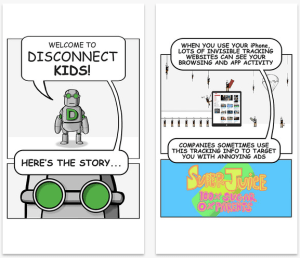
More than 1 million people are using apps and browser extensions each week from Disconnect, the anti-tracking, anti-ad targeting startup to block how third-party sites track your online movements and then serve ads based on those movements. Now it’s taking its campaign to the next generation. Today, the company is launching Disconnect Kids, a free iOS app designed specifically for children (and their parents) to help them control how their web- and app-browsing activity is used, and to educate them about online privacy in the process. It claims that it is the first iOS app designed to “prevent data about your web-browsing and in-app activity from ever leaving your device.”

And given the ongoing revelations about PRISM, the National Security Agency and Internet privacy, there is a kind of poetic justice in the app, too: the technology powering Disconnect Kids was built by Patrick Jackson, an engineer who previously worked for none other than the NSA and now heads up Disconnect’s mobile efforts (one of the company’s new hires after announcing a $3.5 million raise in June this year).

“We’re able to leverage the iOS platform to prevent invisible tracking services from collecting browsing history, in-app activity, location, and other info from a user’s iPhone or iPad,” he said in a statement. Casey Oppenheim, a co-founder at Disconnect, tells TechCrunch that both Android and desktop web versions of the app are also “in the works.”

The idea behind Disconnect Kids is to tap into the hundreds of mobile tracking companies that currently collect data about the browsing and app activity (usually to serve more targeted ads, but also for other purposes in the apps themselves). While a lot of controls have been put into place for apps aimed specifically at children, there is a whole swathe of apps and sites that are used by children as well as adults, which are not restricted in the same way.

“Disconnect Kids aims to close this loophole by letting you actively block major mobile tracking companies and the network connections they try to make to your family’s devices,” notes co-founder and ex-Googler Brian Kennish in a statement. “Until now, nobody had figured out how to stop personal data from leaving an iOS device.”

Disconnect Kids is not the first effort to make sites less tracking-invasive for younger users. There is the COPPA directive from the FTC that covers how apps and sites have to clearly state what information they use about minor users. In the U.K., the Office of Fair Trading is also scrutinizing and considering legislation over how freemium apps and games directed at kids are collecting information. There are also proprietary implementations like Zoodle’s Kid Mode, the Y Combinator-backed Kytephone, KIDO’Z and Play Safe, and every mobile OS now has parental controls built in.

Disconnect Kids takes this one step further to cover all apps used on a device, regardless of what other controls may oversee some aspects of browsing behavior. For example, Oppenheim explains, “COPPA allows sites and apps not directed at children (think YouTube) to continue tracking and targeting unless the site has ‘actual knowledge’ that a child is using the device, which sites and apps often don’t know. So our app is actually aimed at empowering families to pro-actively block tracking and targeting of children even on COPPA compliant sites and apps.”

For now, all of Disconnect’s products remain free and “pay what you want,” a model afforded by the startup’s B Corporation, semi-charitable status, also picked up earlier this year. In future, this could evolve to a more concrete business model, Oppenheim tells us. “It’s possible we’ll make future features premium,” he says.

That stands in contrast to Reputation.com, another site that is banking its business on the increasing consumer demand (and awareness) of data tracking. Its solution is to put all of that information into a “data vault” that users can then better control — which could potentially mean handing over to third parties anyway, but at least getting better compensated for it, and doing so with full awareness of what’s happening. The company has raised more than $68 million, and acquired a number of smaller properties, to make a business of this effort. “They raised a huge amount of money for that idea and I’m interested to see how it works out,” notes Oppenheim.

The Disconnect Kids app is designed with simplicity in mind — so in that regard, and considering that many adult consumers don’t think about or know much about how advertising tracking and targeting works, this could be useful for more than just children.

You can see the app in action in the video below:

In The Future, Google Glass Makes Your Face A Trading Floor So You Can Never Escape Your Portfolio


More and more, wearable computing seems like a very bad idea that will only serve to make it impossible for any of us to disconnect for any amount of time at all. In case you need further proof, take a look at this concept video from Fidelity Labs, which is an early development partner for Google Glass. They’ve just launched Fidelity Market Monitor for Glass, so that watching your net worth rise and fall with the vicissitude of the stock market is now easier than ever.

This is the “first investing Glassware widely available for Google Glass,” the company says, feeding quotes and prices from major U.S. indexes at market close. The current feature set is pretty lightweight, but the concept video shows how it might expand in the future to offer account access, up-to-the-minute market information, news and stock pricing information based on image recognition of things like corporate logos.

Glass is exciting since it’s a brand new product category that could potentially bring about exciting changes in how we live, but it’s also sort of terrifying in terms of just how much it could drive us deeper down the digital rabbit hole. Watching the apps that come out for the platform will help us get a better sense of exactly what kind of dystopian future we’re headed for (or, depending on your perspective I guess, show us the utopia to come).

Carrier-Backed Mobile Wallet Isis Ties Up With Chase, Amex, Ahead Of Nationwide Expansion

Carrier-backed mobile payments initiative Isis is gearing up support for its mobile wallet platform ahead of the nationwide launch later this year. Today, Isis is announcing Chase has signed on to be a part of the national rollout, following the pilot trials in Austin, Texas, and Salt Lake City.

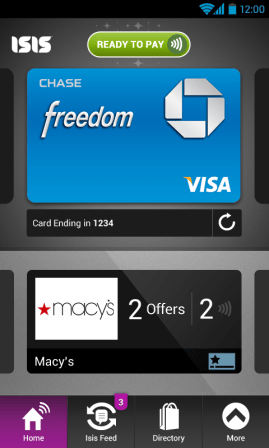
Chase cards supported by Isis now include Chase Freedom, Sapphire, Slate, and JPMorgan Palladium. Isis currently has similar deals with Capital One and American Express.
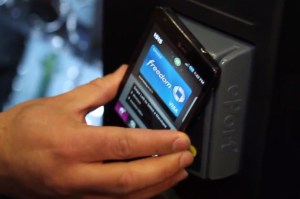
The cards, once loaded into the mobile wallet application on supported phones, can then be used by tapping to pay at NFC-enabled point-of-sale terminals. However, real-world adoption of NFC as a payment method has struggled due to a lack of ubiquitous support for the technology at checkout, as well as consumer confusion over supported phones and how to use NFC if provided. Plus, there’s also the fact that Apple has not adopted the technology in its own devices, including the iPhone.

Isis’s plan B may then involve gaining initial traction as a platform for mobile couponing and loyalty rewards – something the wallet app supports today through its merchant partnership program.

The news of Chase’s support comes just days after Isis announced a partnership with American Express, which will see its own payment application called Serve, integrated into the mobile wallet. Isis and Serve had been working together for over a year, and now mobile customers will be able to sign up for an American Express Serve account in Isis, then use it to pay bills online, or send money to family or friends. Serve accounts are something of an alternative to a bank account, but can be funded through existing bank accounts, credit cards, debit cards, or other Serve accounts.

Isis competes with a variety of attempts at building a functional mobile wallet, including Google’s own NFC-based application, Google Wallet, which has also had troubles at point-of-sale as well as refusal by carriers to support the app so they can move forward with Isis.

Largely, the success of mobile payments in the offline world — at least here in the U.S. — has come from those who avoid tying themselves to NFC. This includes startups like Square, which signed deals with Starbucks and Blue Bottle Coffee to power their payment-processing infrastructures, as well as online payments company PayPal, which has been integrating with point-of-sale system providers, and has established partnerships with dozens of retailers reaching tens of thousands of locations across the U.S. PayPal also has its own Square alternative, with PayPal Here, which recently expanded its U.K. trials.

Isis, jointly run by AT&T, Verizon Wireless, and T-Mobile, limits itself to NFC, which may prove quite challenging, then, in terms of consumer adoption. When an NFC terminal is not present, the fallback for Isis users is to pull out their card and swipe as usual. That’s also a deeply ingrained habit that will be hard to break, especially if the “pay by tap” method doesn’t seem to offer any sort of value add to experience from the checkout.

Isis announced in late July, too, that it would be rolling out nationwide this year, though it did not provide a launch date. The series of announcements, including last week’s around Amex and today’s around Chase, hint that the launch date for the platform is drawing near. Isis’s pilot debuted in October 2012, so perhaps the go-live date will also be October, in order to make it a full year between to the two launches.

After Retrenching In Europe, Fab Raises Another $5M From ITOCHU Corp. In Series D Expansion, Aims For Japan JV By 2014


The march into Asia continues for Fab, the online design retailer that raised $150 million in Series D funding in June. Today, the company announced a further $5 million extension to that round from ITOCHU Corp., a general trading company whose VC arm, ITOCHU Technology Ventures, also participated in the main Series D tranche. Jason Goldberg, Fab’s co-founder and CEO, also notes that the two are also working on a JV that will bring Fab to Japan in 2014.

ITOCHU Corp. is something of an institution in Japan: as a sogo shosha it has been in business or 150 years and has the country’s largest network of third-party logistics warehouses.

“Fab is one of the fastest growing e-commerce companies and the leading online design retailer in the US and Europe,” Shunsuke Noda, Chief Operating Officer of ICT, Insurance & Logistics Division in ITOCHU Corporation, said in a statement published on Goldberg’s blog. “We believe Fab has a huge potential to expand their business in Japan/Asia and we are very excited to work with Fab to realize their long-term vision of being the world’s design store.” Itochu’s VC arm has also invested in other startups such as Ooyala.

This latest injection less than two weeks after Fab announced an additional Series D extension of $10 million from Singapore’s SingTel, another strategic investor that will help the company expand in Asia.

The news of Fab’s sharpening focus on markets in the east comes at the same time that it has reigned in some of its growth in another international market: Europe.

The company in July laid off over 100 people based in its Berlin HQ — we actually heard closer to 150 at the time — a consequence, it says, of repositioning itself away from flash sales. That has also resulted the company also trying out other things, such as more social-media-minded Pinterest- and Fancy-style follower models to help users discover (and hopefully buy) things they might like. Today, some 40% of Fab’s international sales come from the UK, so it’s no surprise that the company is looking to diversify, both in terms of product and geography.

The gradual evolution of the company, however, has also put it into hot water with a Fab of a different stripe: the fashion e-commerce site JustFab is currently suing Fab for trademark infringement and loss of business.

 
Please Click A Facebook "Like" Button