14 August 2013

Nexus 5 Release Date Rumored for October, Made by LG

While recent rumors have hinted that Motorola will make Google’s Nexus 5, a new tip suggests that the search engine giant will stick with LG for its Nexus 4 successor. According to a report from Korea, LG will manufacture the purported Nexus 5 in time for an October launch.

We’re skeptical on this rumor since LG denied that it would be making a new Nexus phone, but Korean site MyDrivers insists that multiple news outlets in Korea are reporting the opposite. What’s more interesting, however, is that Google and LG reportedly plan to keep the same pricing strategy as the Nexus 4.


MORE: 10 Amazingly Dumb Things We Do with Smartphones

According to the report, which we translated from Chinese, the Nexus 5 is likely to come with a Qualcomm Snapdragon 600 processor rather than an 800 if Google keeps the $299 for 8GB and $349 for 16GB price points. The current generation Nexus 4 runs on a Qualcomm Snapdragon S4 Pro.
Like its predecessor, the Nexus 5 will allegedly come with 2GB of RAM but will get a camera upgrade to 10 megapixels as opposed to the Nexus 4’s 8 megapixel sensor. The report also mentions that Google plans to upgrade the display from the Nexus 4’s 4.7-inch WXGA display to a 5-inch 1080p touch screen and will feature a design similar to the new LG G2.

Rumors concerning the Nexus 5 have been inconsistent throughout the past few months, with reports flip flopping between Motorola and LG. Just last week, Motorola tipster Taylor Wimberly posted to Google+ that the Google-owned company would manufacture the new Nexus smartphone, but none of this information has been confirmed.

160 Billion Apps Will Be Downloaded in 2017, Report Says

Smartphone applications help make life simpler, more organized, and entertaining, and a new study predicts that they will be downloaded twice as often in a few years. According to Juniper Research, more than 160 billion consumer apps will be downloaded in the year 2017, which doubles their 2013 prediction of 80 billion.

Juniper predicts that free-to-play games will lead 2017′s app downloads, partially due to the growing multiplayer support for mobile titles (Hello Google Play Games and Apple Game Center). With free apps dominating most mobile marketplaces, the report states that only 5 percent of apps will be paid for when downloaded, which is lower than this year’s 6.1 percent.

Application stores such as Apple’s App Store, Google Play and the Amazon Appstore are expected to continue improving app discovery for shoppers, as in-store recommendations are predicted to become more integral to sales and downloads.

While this is excellent for mobile software developers, it also challenges them to find ways to still profit off of applications that are free upon download. After all, many people choose to live with the in-game ads in the free versions of hit titles like “Words with Friends” and “Draw Something.” Some addictive casual games have mastered the art of in-app purchases, however; we’re looking at you “Candy Crush.”

How to Turn Off Galaxy S4 Location Services


Do you know how many apps on your Samsung Galaxy S4 use Location Services? Some use that data to offer directions, suggest restaurants near you or attach your location to an Instagram photo or Facebook post. These apps likely prompted you to enable Location Services before you started using it, and many people agree to this without thinking. But what you may not know is that your smartphone’s camera is also likely tracking your location.

There are a few reasons you might want to disable location services on your camera, including saving battery power, or more importantly, protecting your family. The location-tagged data in photos can lead predators to your child’s school, playground, daycare and any other places you may regularly use your smartphone. The directions for how to disable Location Services is a little different on each Android device. Here’s how to stop transmitting your location on the Samsung Galaxy S4.

1. Open the Camera app and tap the gear icon on the right of the screen. 
2. Tap the next gear icon that appears on the right of the screen.
3. Tap the gear icon that appears in the next pop-up screen.
4. Tap the gear icon on the right of the pop-up screen. 
5. Tap GPS Tag and toggle off. 
6. Go to your Galaxy S4 Settings Menu to disable more location services. 
7. Tap the More tab on the top right and tap Location Services. 
8. Toggle the top button that reads “Access to my location.” Doing this will disable all other apps on your Galaxy S4 that use your GPS, Wi-Fi or mobile network location to transmit that dat

Samsung ATIV S Neo Available August 16 for $149.99


The wait is officially over for Sprint customers holding out for a Samsung Windows Phone. The carrier officially announced Wednesday that the Samsung ATIV S Neo will launch in stores and online on August 16.

The ATIV S Neo will become the second Windows Phone 8 in Sprint’s lineup, following the HTC 8XT that was released last month. The new device will be available for $149.99 with a two-year plan, after a $50 mail-in rebate. Samsung’s latest Windows Phone runs on a 1.4GHz dual-core processor and has 1GB of RAM, 16GB of memory, and a removable 2,000 mAh battery that’s meant to deliver 14 hours of talking time.

MORE: Samsung ATIV Odyssey: Full Review

The Samsung device packs an 8-MP rear camera as well as a 1.9-MP lens on the front, and has a 4.8-inch, 1,280 x 720 touchscreen for Windows browsing on-the-go. The ATIV S Neo has access to Microsoft Office and Exchange, and features a built-in Kids Corner that allows parents to provide a customized app layout for their children. It’s also Sprint’s first Windows Phone 8 with international roaming.


You can pick up the Samsung ATIV S Neo starting Friday at Sprint.com, an official Sprint store, or your local participating electronics retailer.

How to Create an Email Signature in Microsoft Outlook 2013

Email signatures are like the shoes of the corporate world. Sometimes you just need a short, to-the-point one for chain replies. Sometimes you need a formal, official-looking one. Unfortunately, Microsoft Outlook’s signature options can be somewhat hard to find, buried deep in the abyss of its backstage mode for options.

Here’s how to create a signature in Outlook 2013 in five quick steps.

1. Click New Email at the top left corner of the Home tab.
2. Click Signature from the top panel, next to Attach Item. A dropdown menu will appear, with options to add an existing signature to the email you’re working on. Select Signatures from this menu to open a Signatures and Stationery window
3. Click New in the Signatures and Stationery window to create a new signature template.
4. Compose your signature in the editing window. If you have your contact information already saved in Outlook, you can simply import all that information as a business card by clicking Business Card at the top right of the edit options.
You can add images to your signature, like a logo or banner, by pasting them into the editor or clicking the button to the right of the Business Card button. URLs will be automatically hyperlinked, but if you want to add your own link, you can click the Insert Hyperlink button on the extreme right. Click OK, and your signature will be saved for future use.

5. Designate your new signature as your default in the Signatures and Stationery window if you want to make sure it is included with every new message and replies or forwards you send.
If you don’t want a default signature , you can insert the signature into individual email messages by clicking Signature in the Compose window as in Step 1, and selecting the signature you just created.
Sprint MiFi 500 LTE Review

Pros: Light design; Strong 4G speeds; Simple interface; Long battery life
Cons: Limited Sprint LTE coverage
The Verdict: The Sprint MiFi 500 LTE Hotspot offers good battery life and fast data speeds where Sprint LTE coverage is available.

LG Vu 3 Could Sport 5.2-inch Display, Snapdragon 800 CPU


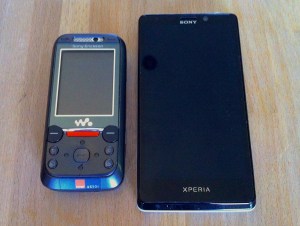
LG is rumored to be working on a new entry in its Optimus Vu series of phablets, and this one will be quite an upgrade from its predecessors. According to the Korean site ASIAE, the Vu 3, LG is dropping the Optimus from its name, is expected to sport a 5.2-inch display. That’s up from the Vu II’s 5-inch screen (pictured above). The Vu 3′s display resolution is also expected to jump from 1024 x 768-pixels to 1280 x 960.

Despite the increase in screen size, the Vu 3 will retain the unique 4:3 aspect ratio found on both the Optimus Vu and Optimus Vu II. That means the phablet will also feature the awkward square design that the originals offered. During our time with the Vu and Vu II, we found them a bit difficult to hold in one hand. Users with smaller hands had an especially hard time gripping the handset. If the rumors are accurate that the Vu 3 will retain the same basic styling, LG may be limiting its audience for the phablet right out of the gate.
MORE: Top 10 Smartphones

The Vu 3 will pack one of Qualcomm’s new quad-core Snapdragon 800 processors, 2GB of RAM and a 13-megapixel rear-facing camera. The phablet may also include a stylus, though hopefully LG provides a slot to store it, rather than making you hold it at all times like the Vu II. Most impressive of all is the fact that the handset could include LTE-Advanced support. Of course, that function would only work in South Korea, where LTE-A networks are currently available.

AndroidAuthority reports that the Vu 3 may see its global launch at IFA 2013 in Berlin next month. If that’s the case, we’ll be on hand to see the phablet live and in person.

How to Turn Off AMBER Alerts on Windows Phone


Designed to notify nearby residents in the vicinity of a missing child, the piercing cry of the AMBER alert can sound at anytime and anywhere. And while the alerts have the noblest intention, many people are calling them annoying and somewhat intrusive as they wake millions of users in the middle of the night. We’ve previously described how to disable AMBER alerts on iPhone, Samsung Galaxy Phones and BlackBerry. Now it’s Windows Phone users turn for some relief and hopefully a good night’s sleep.

To disable AMBER alerts on your Windows Phone:

1. Go to the Start Screen
2. Swipe left to access the Applications list and tap Messaging.
3 Hit the three dots in the lower right corner and select Settings.
4. Click the Emergency Alerts button.
5. Slide the AMBER Alerts tab to the left to turn off the alerts. You can also choose other alert settings (all alerts, Presidential only and Presidential and Extreme alerts) in the Emergency Alerts box below.

Deal of the Day: Dell Inspiron 17R Core i7 Laptop for $650


Our deal experts have combed the web for the best deals around and today we’ve got offers up to 71% off.

Dell is offering their Inspiron 17R 17-inch laptop fully loaded with an Intel Core i7 quad-core CPU, 8GB RAM, 1TB hard drive, and more for just $649.99. Normally, a 17-inch screen and Core i7 processor would cost a big premium, but this deal cuts $150 off the list price.

Alternatively, head over to Amazon and check out their one-day only SanDisk flash memory sale, with flash drives and memory cards started at only $10.49. Also, don’t miss the new Crucial M500 240GB SSD marked down to $194.99. Scroll down to get today’s hottest deals.

Top Deals:
Dell Inspiron 17R : Core i7 Laptop w/ 8GB RAM, 1TB Hard Drive & Backlit Keyboard for $649.99 with free shipping(normally $799.99 – use coupon code P$XLG1LB$SVWWJ ).
240GB Crucial M500: 2.5″ SATA 6Gbps SSD for $194 with free shipping (normally $219.99).
1-day SanDisk Memory Sale!: Up to 60% off SanDisk memory cards & USB flash drives.

Additional Deals:
256GB SanDisk Ultra Plus: 2.5″ SATA 6Gbps Internal Solid State Drive for $159.99 with free shipping (normally $199).
Turtle Beach Call of Duty: Black Ops II X-RAY Wirelesss Headset: Dolby Surround Sound for $99.99 with free shipping (normally $199.99).

The LogicBuy team scours the web every day for the hottest deals and we make our best effort to let you know when they will end, but sometimes deals expire unexpectedly. You can find the next best price on the item you’re looking at LogicBuy.com.

Pinterest Targets Casual Visitors With New “Pinterest For Teachers” Site, May Add More Content Hubs In Future

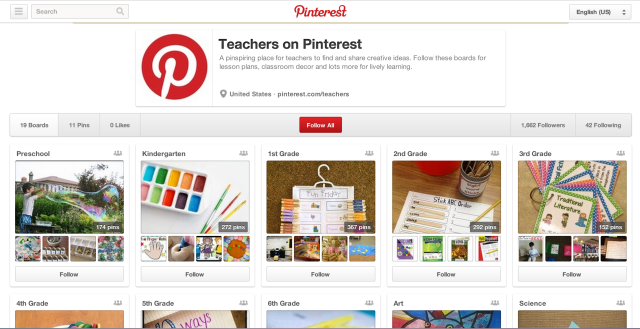
Pinterest has launched what may be the first of several official “hubs” featuring content targeting a particular segment of its user base, with today’s debut of a new “Pinterest for Teachers” site at pinterest.com/teachers. Obviously timed to coincide with the back-to-school rush and news cycle, the company tells us that the new hub will also serve as something of a test to see if it makes more sense to continue down this path in the future, with more hubs devoted to other interests or groups.

The Teachers hub was actually launched a few weeks ago, and grew to 1,300 users ahead of any public announcement or promotion — like today’s company blog post about the new section.

Here, Pinterest explains that it teamed up to work with Edutopia, an online resource for educators, to build out content for the hub, which at launch offers 19 boards, including those focused on preschool and elementary school teachers (grades K-6), as well as topic-based boards on subjects like art, science, math and other things teachers would finding interesting, ranging from classroom decor to recommended blogs. Each board is being maintained by a Pinterest user who’s also a teacher, most of whom also have their own educational websites or blogs, too. The Teachers hub will later expand to cover more areas and grades in the future, the company notes.
In addition to the fact that it’s simply that time of year for a back-to-school marketing push, Pinterest also adds that a teacher-focused board makes sense for the site because it has developed a large community of teachers using its service for tips and tricks, lesson plans, craft and activity ideas, and more. Edutopia cites Pinterest as one of the top five professional websites for teachers, and Pinterest today sees over 500,000 education-related pins added to its service daily.

But the hub’s launch follows several other recent pushes into content recommendations by Pinterest, including the debut of pin and board recommendations, first announced in late July. The company switched on an opt-out mechanism (“do not track”) at the same time – a hint of how deeply it plans to tap into user data in order to personalize the service. And at the end of last month, those same pin suggestions started showing up on mobile as well.

That being said, the Pinterest for Teachers hub is not going to be a part of any sort of personalization efforts right now, but rather will serve as a starting-off point for people coming to the site for the first time, possibly wondering what it’s all about. They may be looking for recommendations, such as whom to follow, or they may just want to browse around for inspiration. The hope is that by offering users the hub as a starting-off point (you can click around its pages without needing an account), those more casual visitors will eventually convert and create boards of their own, we’re told.

Pinterest evaluates whether or not all these plans hold up – not necessarily by looking at hard numbers, but at community engagement and feedback, including things like comments on today’s blog post or on its Facebook page, among other things.

Though the company does not have publicly announced plans for other hubs, the service is also seeing traction in categories like Food, Fashion, Design, Technology and the Outdoors. If it decides the hub concept works, these will likely be the next areas the company will explore.

Following Comical Scrap With Google, Microsoft’s YouTube App Will Return To Windows Phone Today


Well, Windows Phone fans, you are almost home. Today Microsoft’s YouTube application for Windows Phone will return to the platform’s marketplace.

At last, Google and Microsoft appear to have worked out a compromise that will allow for a fully featured YouTube experience on the latter’s mobile platform. Google and Microsoft have had a fraught year, bickering over email syncing, search dominance and mobile mapping. And the YouTube thing.

Microsoft had pulled its home-built YouTube app for Windows Phone from its mobile store following vociferous Google complaints that resulted in a cease-and-desist letter.

The stakes are somewhat high, if in the distance: Microsoft is hell-bent on building a first-tier mobile platform. Google is dedicated to Android’s continued hegemony. It has scant incentive to grant Microsoft even one extra scrap of oxygen. Windows Phone users have been somewhat caught in the crossfire.

Google once extended its support of Exchange ActiveSync at the proverbial last minute, granting Microsoft enough time to support its CalDAV and CardDAV syncing systems to keep Windows Phone users, who depended on Google web services, happy.

TechCrunch reached out to Microsoft, which provided the following statement: “We’ve released an updated YouTube app for Windows Phone that provides the great experience our consumers expect while addressing the concerns Google expressed in May, including the addition of ads. We appreciate Google’s support in ensuring that Windows Phones customers have a quality YouTube experience and look forward to continuing the collaboration.”

Users will be able to live stream YouTube content that is ongoing, and upload video from their phones.

What matters more than the generic feature breakdown of the application is that it exists at all, at last, with full coronation from both parties. That’s something to be applauded. It has been a scrap for Microsoft to fight for a place at the table. Each time Microsoft has butted heads with the Mountain View search giant, it has always done well by its users in the end. So, if you are a Windows Phone user, here’s a clip to get you started.

Smartphones Finally Overtook Dumbphone Sales Globally In Q2, Android Now At 79%, Says Gartner

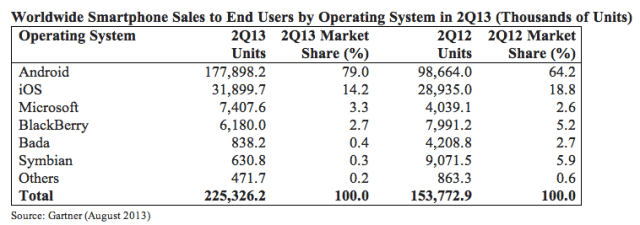
Analyst Gartner has put out its latest smartphone market report, and the Q2 2013 numbers show the inevitable finally occurred: smartphone sales exceeded feature phone sales for the first time. Android has been strangling the life out of dumbphones for years, but it looks like the market tipping point is being reached.

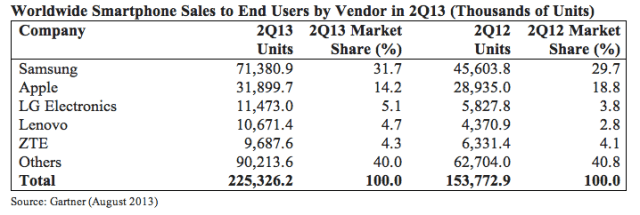
In Q2, Gartner says worldwide smartphones sales rose 46.5% from the year earlier quarter to hit 225 million units shipped, while sales of feature phones declined 21% year-on-year to 210 million units. Smartphone shipments grew most in Asia Pacific, Latin American and Eastern Europe, with growth rates of 74.1%, 55.7% and 31.6% respectively, but the analyst said sales grew in all regions. IDC‘s recent market figures put Android on approaching 80% worldwide marketshare for Q2. Google’s mobile OS is clearly expanding its share by picking up former feature phone users.

The rising tide of global smartphone ownership is raising all boats, but Samsung continues to dominate the smartphone landscape. Gartner said Samsung grew its share to approaching a third (31.7%), up 29.7% on Q2 2012. Apple also grew shipments of its iPhone but its marketshare declined — highlighting the case for Cupertino to make a low cost iPhone to capture growth at the budget end of the market. Apple took a 14.2% share in Q2, 2013, vs 18.8% in the year ago quarter. It still shipped 10.2% more iPhones vs Q2 2012 but is being outpaced by higher smartphone market growth rates.

After Samsung and Apple, it’s a tale of all Asian smartphone makers battling for third place: LG grabbed third place in Q2 (with a 5.1% share); followed by Lenovo (4.7%) whose Lephone has been a popular seller in China; and ZTE (4.3%).
Gartner said Apple saw a significant drop in the average selling price (ASP) of its devices in Q2, with its ASP declining to the lowest figure registered by Apple since the iPhone’s launch in 2007. This is down to strong sales of the iPhone 4 — again underlining the case (from a volume perspective) for Apple to launch a cheaper iPhone. However doing so would clearly accelerate that decrease in its ASP, even if market growth is now being powered by budget devices — providing the impetus for Apple to expand the iPhone to cheaper price-points still.

“While Apple’s [declining] ASP demonstrates the need for a new flagship model, it is risky for Apple to introduce a new lower-priced model too,” commented Gartner analyst Anshul Gupta in a statement. ”Although the possible new lower-priced device may be priced similarly to the iPhone 4 at $300 to $400, the potential for cannibalisation will be much greater than what is seen today with the iPhone 4. Despite being seen as the less expensive sibling of the flagship product, it would represent a new device with the hype of the marketing associated with it.”

Also noteworthy in Q2, Microsoft’s Windows Phone platform pushed past BlackBerry’s OS for the first time to take third place. When Windows Phone launched, back in 2010, Steve Ballmer and Nokia’s CEO Stephen Elop talked of their ambition to create a third ecosystem in the smartphone space. They’re still trying to stock the fires of an ecosystem but are at least in third place from a sales perspective.

Windows Phone took a 3.3% global market share in Q2 vs just 2.7% for the struggling BlackBerry OS. Gupta, noted: “While Microsoft has managed to increase share and volume in the quarter, Microsoft should continue to focus on growing interest from app developers to help grow its appeal among users.”

Taken together, Android and iOS took a 93.2% global marketshare in the quarter — underlining why developers opt to support these two platform first and foremost, and generally require incentives to expend effort elsewhere. Android’s global marketshare in Q2 was a staggering 79% according to Gartner, up from 64.2% in the year ago quarter — buoyed by feature phone switchers.
The drop off in feature phone sales is bad news for Nokia, which still leans heavily on its feature phone business (being as its smartphone business is tied to the Windows Phone underdog). Nokia shipped just 61 million feature phones in Q2, down from 83 million in the year ago quarter. But the Finnish mobile maker is at least seeing some decent growth in smartphones, thanks to having a broader portfolio of devices to offer at different price points. Nokia’s Windows Phone-powered Lumia sales grew 112.7% in Q2 2013, according to Gartner.

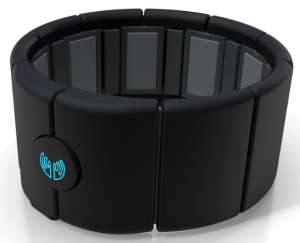
Thalmic Labs Gets Two Ex-BlackBerry Execs (Including One Who Just Left) To Help The MYO Armband Succeed

Thalmic Labs has picked up some heavyweight senior talent in its quest to bring the MYO gesture control armband device to market. Both are ex-BlackBerry, and both bring a lot of experience in the management of a consumer devices company, and in the supply chain for producing said devices.

Thalmic’s newest employees are Mike Galbraith, former SVP of Operations at BlackBerry, and David Perston, former Senior Director of New Product Introduction Outsourcing at the smartphone-maker. Galbraith becomes CFO of MYO, and Perston takes on a role as VP of Manufacturing. Given that arguably the two biggest challenges facing hardware startups are working out finances and managing the supply chain and production process, having some folks with experience in those roles is likely a good thing.

Galbraith comes direct from BlackBerry, which is just the most recent example of corporate shake-up and high-level departures at BlackBerry. BlackBerry just lost three executives last week, in fact, according to a report from the CBC confirmed by the company. As Chris reported at the time, BlackBerry seemed to be framing the departures as part of its aggressive reorganization and turnaround plan, but the recent announcement that it’s looking for suitors as well as considering going private offers good reason to believe top talent is leaving of its own volition.

“What really attracted me to Thalmic Labs was the innovative solution that Stephen, Aaron and Matthew are creating that has the potential to take human computer interaction to a whole new level,” Galbraith offered when asked why he chose Thalmic for his next destination. “I firmly believe there are boundless opportunities with MYO’s unique position within the dynamic wearable computing space. I was also impressed with Stephen, Aaron and Matthew’s vision for MYO and beyond, in developing integrated solutions to enhance how we engage with things in our world.”
Perston, who left BlackBerry back in 2011 after nearly 15 years at the company, said that his “first love is startups” and cited the team and the product itself as his main motivation for joining. In both cases, it seems clear that Thalmic has gained from BlackBerry’s misfortunes of late.

The new hires and rapid growth of the Thalmic team, which is on track to surpass 50 employees by the end of the year, reflects the unintended bounty that could befall the Kitchener-Waterloo region as BlackBerry continues to struggle. It’s likely there will be a lot of talent injected into the market for the growing startup scene in the area to take advantage of, and that’s something investors are taking note of.

13 August 2013

How To Build A Raspberry Pi-Based Bitcoin Mining Rig


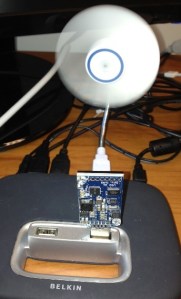
While you won’t get rich running a single Raspberry Pi Bitcoin Rig, you can probably make back your initial investment in this ingenious little machine. RaspPi Bitcoin rigs are nothing new but Dave Conroy has just built one and, more important, shared his plans in a fairly easy-to-read page.

The system uses the Pi as a main processor and a 330MH/s ASIC. In total he spent $127 on his kit and, as far as we can tell, the power outlay will be negligible.

The system uses an ARM-centric mining OS called MinePeon. It is basically a version of Arch Linux ARM with a few mining apps thrown in. Then all you need is a Bitcoin wallet and a little bit of time. Given that you’ll be mining at a maximum of 330MH/s, you probably will be seeing pennies a day, if that. If you’re absolutely new to Bitcoin, you can learn a bit more about how to set up all the accounts and wallets here. I think the real point, however, is the novelty of the kit.

It’s cool to see this little rig running and I think the wee USB-powered fan on top of it is the crowning touch. Put a couple dozen of these in a room and you could probably really do some damage and your farm will look sort of like Pikmin, which is a bonus.

Adobe Updates Muse With Improved Tools For Building Long-Scrolling Sites

One design trend that seems to have taken the web by storm over the last few months is long-scrolling sites. These sites, the most well-known being the New York Times’s Snow Fall project, use advanced HTML5 and CSS techniques to tell stories (or put marketing copy) on a single site with plenty of visual effects. Adobe Muse, Adobe’s Creative Cloud-based visual web design tool, started to embrace this trend in its last few updates and today, its latest version adds a few new tools that make building these sites easier.

Adobe says today’s release “includes top-requested enhancements for creating scroll motion effects that work on desktop and mobile devices.” This means, for example, it’s now easier for designers to experiment with scroll effects through a new — and imaginatively named — Scroll Effects panel. These effects are also now more tightly integrated into the rest of the application’s tools, so you can, for example, create a persistent menu that updates automatically as you scroll down a page (check out the video below for what this looks like).
With this update, Adobe says, these effects now also work significantly smoother on tablets and smartphones, thanks to improvements in the code that the tool automatically generates when you publish a site.

While the scroll motion effects are clearly the highlight of the release, an Adobe spokesperson also told us that this new version now features the ability to use Muse Forms with any hosting provider that supports PHP (that’s virtually all of them), as well as in-browser editing of Adobe Muse-generated sites hosted with Adobe and a new layers panel. The tool also now supports vertical text.

Fitbit Raises $43 Million From Qualcomm Ventures, SAP Ventures, And SoftBank Capital


Fitbit, a startup which makes a wide range of digital fitness trackers and health devices, has closed a $43 million funding round, according to an SEC filing. The funding comes as the market for health trackers is heating up, with more money being invested in the space.

Earlier this spring, TechCrunch reported that Fitbit was looking to raise $30 million in growth equity at a $300 million valuation, but it looks like the company was able to raise even more than that.

Update: Fitbit has confirmed the funding, saying that Qualcomm Ventures, SAP Ventures, and SoftBank Capital invested in this round, along with existing shareholders Foundry Group and True Ventures.

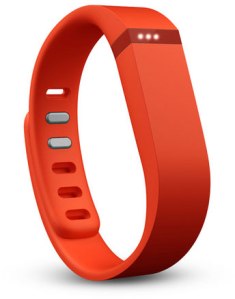
Fitbit makes a number of devices for tracking your overall fitness. There’s the Fitbit One, the Fitbit Zip, and the Fitbit Flex, all of which track movement. The company also has a smart scale for keeping track of your weight, and online and mobile tools for keeping all of that data together in one place, while also allowing users to track calorie intake and other info.

The company hopes to use the funding to release new products and grow its global footprint. Over the last twelve months, it’s been expanding aggressively into the EMEA and Asia-Pac regions. It’s also grown its domestic sales to include more than 15,000 retail outlets in the U.S., while gaining traction with corporate wellness programs as well.

Of course, there’s increased competition in the health tracker market, with competitors like the Nike Fuelband, the Jawbone Up, as well as the recently released Withings Pulse and the Misfit Shine. But anyone who’s tried to buy a Fitbit Flex over the last few months knows it’s been in high demand — I somehow managed to find one about six weeks ago, but the Flex has mostly been on backorder since it was released earlier this year.

And Fitbit isn’t the only player raising money in this space: Last month, Withings brought in $30 million in new funding to expand internationally. And while it’s more of a software platform than a device manufacturer, MyFitnessPal just raised $18 million in funding from Kleiner Perkins and Accel Partners.

Help Crowdfund This All-Seeing Doorbell To Become The Sauron Of Your House

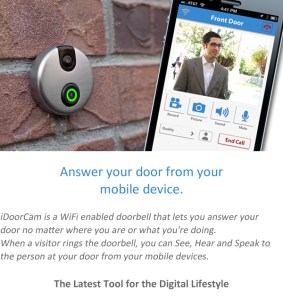
The all-seeing iDoorCam is a pretty ingenious little gadget. Designed to work with your current doorbell setup — it connects to the transformer that powers most in-home doorbells — this simple button replaces your current doorbell and allows you to see who is at the door and even turn off your doorbell when the baby is asleep or you just need a little peace and quiet. It even transmits video and audio to your cellphone so you can deal with visitors while away from home.

The project comes to us from the team of Andrew Thomas and Desiree Mejia, two product designers from California. They have built hardware for Apple and they’ve taken their skills and expertise to corner the doorbell market. They are looking to ship in October.

The doorbell costs $127 for early adopters, and they’re looking for a pledge of $100,000 to complete the first batch. It will cost $150 retail when it officially launches.

Sadly, unlike the Lidless Eye of Sauron, lieutenant to the Dark Lord, Morgoth, the iDoorBell will not allow you to take over the minds of weak-willed hobbits who may come by your hole for elevenses. However, you can carefully explain to the UPS guy that leaving a huge package under your doormat is not actually “hiding it.”

Twitter Buys Open Source Training Company Markana To Power New “Twitter University” For Engineers


Twitter today announced its latest acquisition, along with a move into offering richer resources to attract better engineering talent to the company. It’s acquiring Marakana, an open-source technical training company. It, in turn, will be the force behind a new effort called Twitter University (school mascot: a blue bird, not a whale).

“The founders, Marko and Sasa Gargenta, have impressed us with their entrepreneurial leadership, commitment to learning and technical expertise,” writes Chris Fry, the head of engineering at the company in a blog post.

The move is an important sign of a couple of things:

First, as Twitter has grown — and become a more mature company now well past the stage of scrappy startup — it’s already made several moves to provide training to help people at the company continue to feel that they are there learning new things, as well as working on projects that make the most of what they already know. Existing training projects, Fry notes, include orientation classes for engineers, iOS Bootcamp, JVM Fundamentals, Distributed Systems and Scala School. It’s important for Twitter to continue to grow these kinds of services to hold on to the people that they have.

Second, establishing something like this, and putting Marakana at the helm of it, could introduce a whole new community of engineers to the company — no small thing at a time when tech companies big and small continue to hunt for top talent, especially in competitive markets like Silicon Valley and the Bay Area. Indeed, this is something that Fry points out, too:

“The Marakana team has cultivated a tremendous community of engineers in the Bay Area, and we look forward to engaging with all of you at meet-ups and technical events.”

Third, Twitter has made some strong efforts contributing to open source projects over the years (here, here and here are examples), and so this builds on that credibility as well.

Blog post below. More to come.

As Twitter has scaled, so too has our engineering organization. To help our engineers grow, it’s important for them to have access to world-class technical training, along with opportunities to teach the skills they’ve mastered. To that end, we’re establishing Twitter University.

Twitter University builds on several existing efforts at Twitter. We currently offer employees a whole swath of technical trainings, from orientation classes for new engineers to iOS Bootcamp, JVM Fundamentals, Distributed Systems, Scala School, and more for those who want to develop new skills. Most of these classes are taught by our own team members, and many of them have been organized during our quarterly Hack Weeks –– a testament to our engineers’ passion for learning and education.

I’ve been inspired by these efforts. Being able to continually learn on the job and develop a sense of expertise or mastery is a fundamental factor in success in the technology industry and long term happiness at a company. Twitter University will be a vital foundation for our engineering organization.

To lead the program, we’ve acquired Marakana, a company dedicated to open source training. We’ve been working with them for several months. The founders, Marko and Sasa Gargenta, have impressed us with their entrepreneurial leadership, commitment to learning and technical expertise.

The Marakana team has cultivated a tremendous community of engineers in the Bay Area, and we look forward to engaging with all of you at meet-ups and technical events. Additionally, we’ll continue to contribute to open source software, and we aim to release some of the Twitter University content online to anyone who’d like to learn. You can keep up with Twitter University by following @TwU.

We want Twitter to be the best place in the world for engineers to work. Join us.

StumbleUpon’s Cody Simms To Depart, Replaced By New VP Of Product David Marks


Content discovery service StumbleUpon is getting a new head of product.

Chief Product Officer Cody Simms told me he will be transitioning to an advisory role with the company at the end of August. Meanwhile, David Marks (pictured), co-founder of content recommendation engine Lumia (where he served as both CTO and CEO, though not at the same time), joined StumbleUpon as its new vice president of product on July 29.

Simms left his VP position at Yahoo to join StumbleUpon about a year ago — a switch that also involved moving from Los Angeles to San Francisco. When I emailed to ask why he’s leaving, he said:

StumbleUpon has a great mission and team, an innovative business model and is solving an incredibly interesting problem. My family and I recently made the decision, however, to return to family and friends in Los Angeles. As a StumbleUpon management team, we’ve worked together to ensure a clean transition during this time, and we’re excited to say that David Marks joined StumbleUpon just recently to take on the the role of VP Product.

A StumbleUpon spokesperson told me that despite the slightly different titles, Marks is taking on Simms’ role, which involves overseeing product management and design for all consumer and ad products. (When Simms first joined the company, he was also vice president of product.)

“We are excited to have someone with David’s personalization experience on board,” the company said.

StumbleUpon says it now has more than 30 million registered users and 100,000 advertisers.

For those of you who need a refresher on its somewhat complicated history, StumbleUpon was founded in 2001, acquired by eBay in 2007, then bought back and spun out by the original founders (with support from investors) in 2009. Co-founder Garrett Camp stepped down from the CEO role last year, and in January new CEO Mark Bartels announced that he was cutting 30 percent of staff with an aim of getting the company to profitability.

Investor Carl Icahn Admits Large Apple Position, Lobbies For Larger Stock Buyback Program


Today activist investor Carl Icahn indicated on Twitter that he has amassed “a large position” in the computing giant Apple. Following, in another tweet, he stated that in a conversation with current Apple CEO, he had “discussed [his] opinion that a larger [stock] buyback should be done now.”

Another conversation would follow, the tweet went on to say.

Icahn’s twin Twitter missives have sent Apple’s stock 4% higher, adding more than $10 billion to the company’s market capitalization. What Icahn is pressing for is that Apple deploy more of its tectonic cash reserves to repurchase its shares from the public.

This would concentrate future per-share earnings on remaining outstanding shares in the company, raising their per-unit value. Icahn, naturally, owns many of those shares. Thus, the value of his claimed “large” stake in Apple would increase, boosting his personal wealth.

If this sounds awfully familiar, you merely have a good memory. What Icahn is proposing here, or perhaps demanding, is similar to what he proposed for Dell: That the company tender a higher per-share price for nearly all the company’s public equity, greatly boosting the per-share incomes of the shares that he would control. It was a great idea, for Icahn.

What somewhat humorous about all of this is that with a mere two tweets, Icahn moved billions in market value. I wouldn’t think that Apple is too excited to see its private discussions put into the public record in this fashion.

Apple currently pays a cash dividend of more than $3 per share, and in its most recent quarterly earnings report stated that it was “pleased to have returned $18.8 billion in cash to shareholders through dividends and share repurchases.”

Icahn wants more, and Apple can afford it. The issue at hand is that much of Apple’s cash is overseas, and thus expensive to use here. If Apple repatriates the funds, they will be charged the full US corporate tax rate. However, the company found a way around the issue earlier this year, floating a $17 billion bond measure that will, to quote Reuters, fund its “ambitious program that will return $100 billion in cash to holders of Apple shares.”

$18.8 billion thus far, out of a coming $100 billion, and Icahn wants to step on the gas. It’s up to Cook now. Investors, for the time being, are optimistic.

 
Please Click A Facebook "Like" Button